 Jerusalem Old City Tour
The Via Dolorosa: Walking the 14 Stations of the Cross in Jerusalem
The Via Dolorosa is the 600 m route through Jerusalem's Old City that tradition links to the path Jesus carried the cross, marked by 14 Stations of the Cross. Nine stations sit in the streets of the Muslim and Christian quarters and five lie inside the Church of the Holy Sepulchre. This guide walks the route station by station, with what each one marks, where it stands, the churches along the way and their hours, and the Friday Franciscan procession. If you would rather walk it with a guide, the Footsteps of Jesus Walking Tour in Jerusalem covers the route on a full-day itinerary, and the comparison of Jerusalem Old City tours shows every option side by side. The bookable tours are compared on Jerusalem Old City tours.
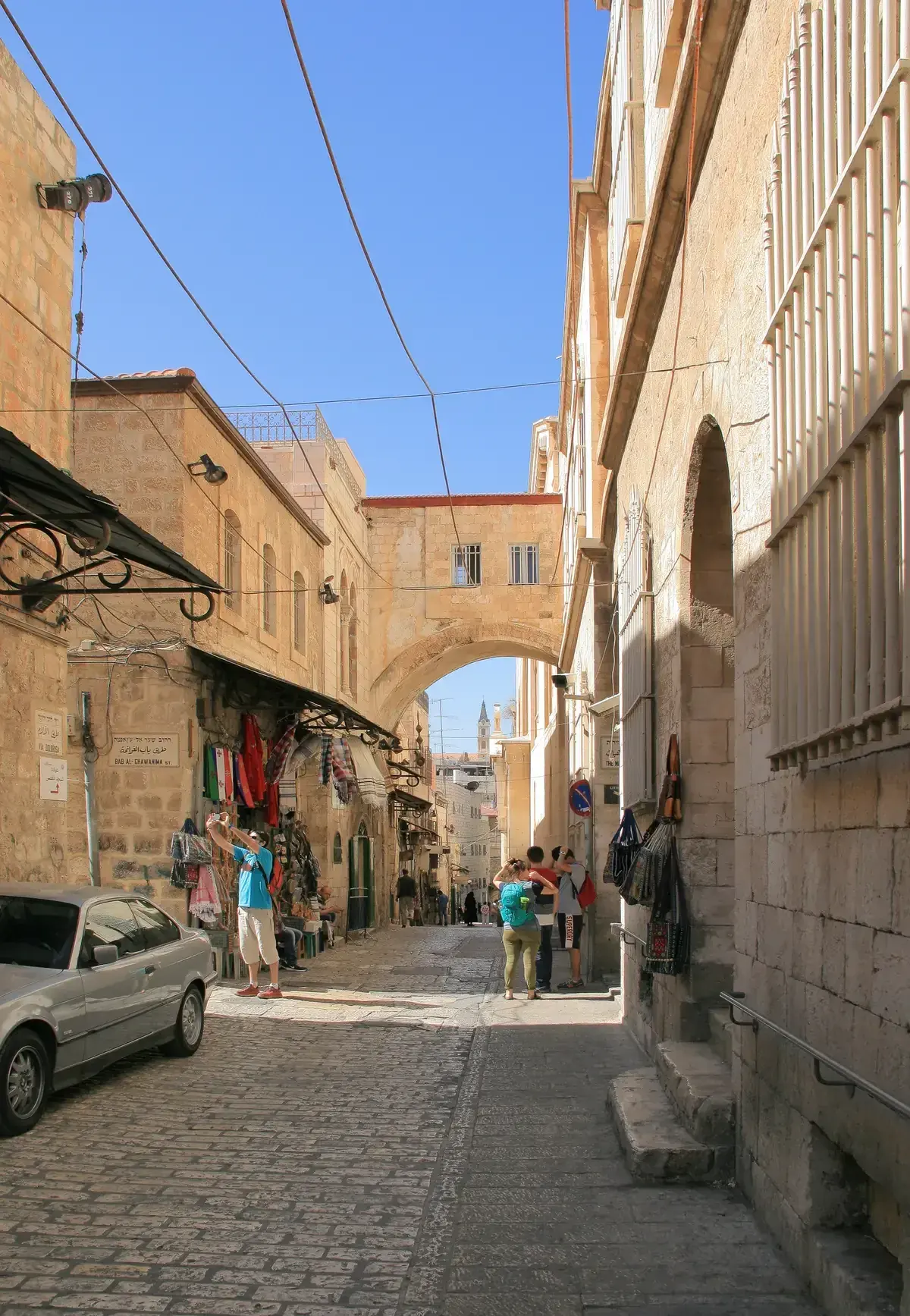
A cobbled stretch of the Via Dolorosa in the Muslim Quarter, with the Ecce Homo arch ahead. Photo: Ludvig14, CC BY-SA 4.0, via Wikimedia Commons
Quick answer The Via Dolorosa at a glance
The Via Dolorosa is a route of about 600 m in Jerusalem's Old City, marked by 14 Stations of the Cross. It runs from the area of the former Antonia Fortress near Lions' Gate to the Church of the Holy Sepulchre. Nine stations stand in the streets and five inside the church. The walk itself is short, and the time you need depends on which churches you enter.
Key takeaways
- Follow every stop in order in the 14 Stations table, with what each marks and where it stands.
- Prefer a guided walk? The Footsteps of Jesus Walking Tour spends a full day on the Christian route for $89 per person, and the Old City Half-Day Tour covers the route in 3 hours for $39.
- The route crosses two quarters. See how they fit together in the guide to the four quarters of Jerusalem.
- The last five stations end inside the Church of the Holy Sepulchre, which has its own detailed guide.
The Route in Brief
The Via Dolorosa is short. The streets take minutes, the stops take the time.
Length, Start and End
The route runs about 600 m through the Old City, which itself covers only 0.9 square kilometres. It starts near the site of the former Antonia Fortress in the Muslim Quarter, close to Lions' Gate, the north-eastern gate that Christians also call St Stephen's Gate and that tradition names as the way pilgrims enter for this walk. It ends at the Church of the Holy Sepulchre in the Christian Quarter. Lions' Gate was built in 1538 and 1539 and stands about 13.7 m tall, with four animal carvings that historians read as leopards of the Mamluk sultan Baibars, even though the common name says lions.
The distance is short, and the time you need depends on how many stations and churches you stop at, from the Church of the Flagellation and the Lithostrotos to the Holy Sepulchre. The Jerusalem Old City map page shows the line of the route against the walls and gates.
- Distance: about 600 m
- Start: near the former Antonia Fortress, reached from Lions' Gate
- End: the Church of the Holy Sepulchre
- Quarters crossed: Muslim Quarter, then Christian Quarter
- Stations: 9 in the street, 5 inside the church
How Long to Allow
Budget by what you want to do. The Lithostrotos and Ecce Homo Basilica is open 8:00 to 17:00, and the Holy Sepulchre is open 5:00 to 20:45 in summer and 4:00 to 19:00 in winter. A guided option compresses this: the Footsteps of Jesus Walking Tour in Jerusalem takes 9 hours with hotel pickup and covers the Mount of Olives, the Pool of Bethesda, St Anne Church and the Via Dolorosa, though entrance fees are not included in its $89 per person price.
The cheapest guided route through the same streets is the 3-hour Old City Half-Day Tour at $39 per person, capped at 25 travellers, which also lists the Via Dolorosa and the Holy Sepulchre among its stops.
The Friday Procession
Every Friday a Franciscan-led Catholic procession walks the Via Dolorosa. The Franciscan Via Crucis begins at the Omariyeh School, across from the Flagellation Monastery by the first station, and follows the street to the Anastasis in front of the Edicule in the Holy Sepulchre. It starts at 16:00 in summer and 15:00 in winter.
If you want the street to yourself, go at another time. If you want the procession, arrive at the Omariyeh School before the start. The daily procession inside the Holy Sepulchre itself, a separate event, starts at 17:00 in summer and 16:00 in winter.
What the Name Means
Via Dolorosa is Latin for the way of sorrow or the way of suffering. The name refers to the tradition that the route follows the path Jesus walked carrying the cross to Calvary. The 14 stations mark episodes in that account, from the condemnation at the former Antonia Fortress to the burial in the tomb.
The plaques mark where tradition places each episode.
The 14 Stations, One by One
All 14 stations, what tradition marks at each, and where each one stands. Figures come from the route's own published descriptions and the Christian Information Center hours list.
The Station Table
The table below lists all 14 stations in walking order. Nine are in the street between the former Antonia Fortress and the Holy Sepulchre. Five are inside the Church of the Holy Sepulchre, which keeps its own guide page.
Note the numbering conflict at station 9 in the next block.
| Station | What it marks | Where |
|---|---|---|
| 1 | Jesus is condemned to death | Area of the Umariya school, on the site of the former Antonia Fortress |
| 2 | Jesus takes up the cross | Church of the Condemnation and Imposition of the Cross and Church of the Flagellation, with the Ecce Homo church also listed |
| 3 | Jesus falls for the first time | Polish Catholic chapel at the west end of the eastern Via Dolorosa |
| 4 | Jesus meets his mother | Armenian Catholic Church of Our Lady of Sorrows |
| 5 | Simon of Cyrene carries the cross | Franciscan chapel built in 1895 |
| 6 | Veronica wipes the face of Jesus | Church of the Holy Face and Saint Veronica |
| 7 | Jesus falls for the second time | Franciscan chapel at a main crossroad, built in 1875 |
| 8 | Jesus speaks to the women of Jerusalem | Greek Orthodox Monastery of Saint Charalampus |
| 9 | Jesus falls for the third time | Entrance of the Ethiopian and Coptic monastery near the Holy Sepulchre |
| 10 | Jesus is stripped of his garments | Inside the Church of the Holy Sepulchre |
| 11 | Jesus is nailed to the cross | Inside the Church of the Holy Sepulchre |
| 12 | Jesus dies on the cross | Inside the Church of the Holy Sepulchre |
| 13 | Jesus is taken down from the cross | Inside the Church of the Holy Sepulchre |
| 14 | Jesus is laid in the tomb | Inside the Church of the Holy Sepulchre, at the Aedicule |
Stations 1 to 5: the Muslim Quarter Stretch
Station 1 sits in the area of the Umariya school, on the site of the former Antonia Fortress. Station 2 is the richest stop of the whole route: it is marked at the Church of the Condemnation and Imposition of the Cross and the Church of the Flagellation, and the Ecce Homo church is also listed for it. The Church of the Flagellation is open 7:00 to 18:00 in summer and 7:00 to 17:00 in winter, and its Terra Sancta Museum is open 9:00 to 18:00 in summer and 9:00 to 17:00 in winter. The Lithostrotos and Ecce Homo Basilica keeps fixed hours, 8:00 to 17:00, and. The Flagellation Monastery is where the Friday Via Crucis assembles at the Omariyeh School across the street.
Station 3, the first fall, is a Polish Catholic chapel at the west end of the eastern Via Dolorosa. Station 4, the meeting with Mary, is at the Armenian Catholic Church of Our Lady of Sorrows. Station 5 marks Simon of Cyrene, the man the account says was pulled from the crowd to carry the cross, and it is set in a Franciscan chapel built in 1895. The Muslim Quarter held about 21,850 residents in 2020, the most of the four quarters.
Stations 6 to 9: to the Church Doors
Station 6 marks Veronica, who according to tradition wiped the face of Jesus, and it is kept at the Church of the Holy Face and Saint Veronica. Station 7, the second fall, stands at a Franciscan chapel from 1875 at a main crossroad. Station 8, where Jesus speaks to the women of Jerusalem, is marked at the Greek Orthodox Monastery of Saint Charalampus. Station 9, the third fall, is placed at the entrance of the Ethiopian and Coptic monastery near the Holy Sepulchre.
That station 9 placement carries a numbering conflict. The Wikipedia route description counts nine street stations and places station 9 outside, at the monastery entrance, with stations 10 to 14 inside the church. The city's tourism portal instead lists stations 9 to 14 as inside or beside the church. The safe reading is the one both sides support: the last five stations are in or beside the Church of the Holy Sepulchre, and station 9 stands at the Ethiopian and Coptic monastery entrance near the church. The Ethiopian monastery of Deir es-Sultan covers about 1,800 square metres of the church roof above the Chapel of St Helena. What waits inside, from the Stone of Unction to the Aedicule, is covered page by page in the Church of the Holy Sepulchre guide.
The Friday Procession
Once a week the Via Dolorosa is walked in a procession led by the Franciscans.
When and Where It Starts
The Franciscan Via Crucis runs every Friday afternoon. It begins at the Omariyeh School, across from the Flagellation Monastery in the Muslim Quarter, which stands by the first two stations. In summer the procession sets off at 16:00 and in winter at 15:00. The walk follows the Via Dolorosa from the Flagellation convent and ends at the Anastasis, in front of the Edicule inside the Church of the Holy Sepulchre.
If you want to join or watch, arrive at the Omariyeh School before the start. Walking the route on your own beforehand is the easiest way to learn the station positions.
- Day: every Friday
- Start: the Omariyeh School, across from the Flagellation Monastery
- Time: 16:00 in summer, 15:00 in winter
- End: the Anastasis, in front of the Edicule in the Holy Sepulchre
Walking It Yourself on Other Days
On other days you can move at your own pace between the station plaques. The route is only about 600 m long, so the time depends on which churches you enter. Friday is the day to see the route used as a procession.
Sources: Via Dolorosa, Christian Information Center
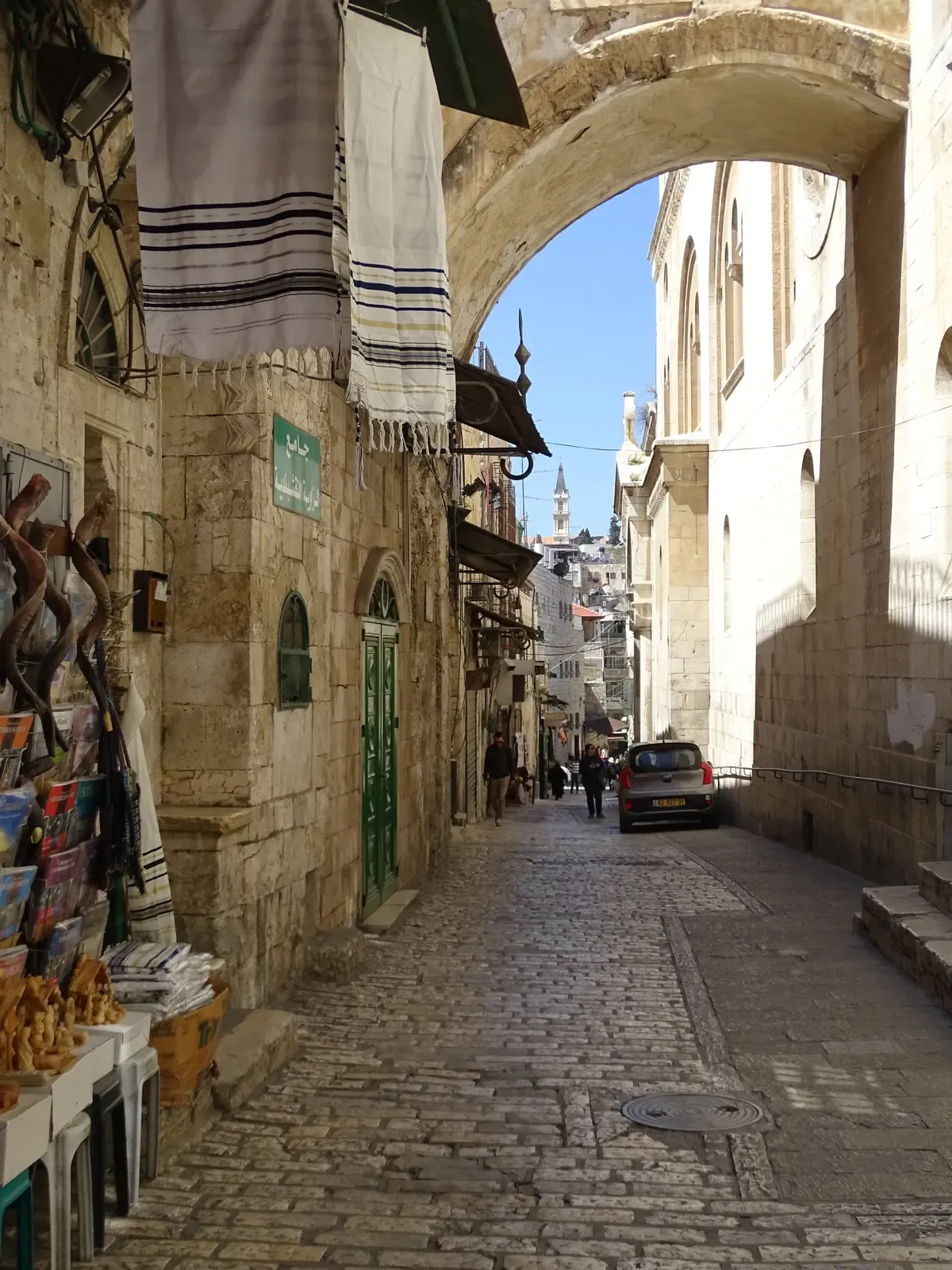
The Ecce Homo arch spanning the Via Dolorosa. Photo: -jkb-, CC BY-SA 3.0, via Wikimedia Commons
Churches Along the Way
The sites along the route each have their own hours and fees.
Church of the Flagellation and the Terra Sancta Museum
The Church of the Flagellation stands by Station 2, where Jesus is held to have taken up the cross. It is open 7:00 to 18:00 in summer and 7:00 to 17:00 in winter. The convent's Terra Sancta Museum is open 9:00 to 18:00 in summer and 9:00 to 17:00 in winter.
Entry hours come from the Christian Information Center's list of holy places.
Lithostrotos and Ecce Homo Basilica
The Lithostrotos and Ecce Homo Basilica is also named for Station 2. The site is open 8:00 to 17:00. The Christian Information Center's list gives hours only and no entrance price for the Ecce Homo, so the fee is not stated.
St Anne and the Pools of Bethesda
The Basilica of St Anne and the Pools of Bethesda are a stop on several guided walks of the area. The site charges ₪12 for adults and ₪10 for students. It is open Monday to Saturday 8:00 to 12:00 and 14:00 to 16:00 and is closed on Sunday.
The St Anne museum on the site opens Tuesday, Thursday and Saturday 9:00 to 12:00 and 14:00 to 16:00.
| Site | Hours | Fee |
|---|---|---|
| Church of the Flagellation | 7:00-18:00 summer, 7:00-17:00 winter | not stated |
| Terra Sancta Museum | 9:00-18:00 summer, 9:00-17:00 winter | not stated |
| Lithostrotos and Ecce Homo | 8:00-17:00 | not stated |
| St Anne and Bethesda | Mon-Sat 8:00-12:00 and 14:00-16:00, closed Sunday | ₪12 adult, ₪10 student |
| St Anne museum | Tue, Thu, Sat 9:00-12:00 and 14:00-16:00 | not stated |
A Break Above the Route
At Via Dolorosa 37, the Austrian Hospice was founded in 1854 and calls itself the oldest Christian guesthouse in the Holy City. Its rooftop, the Schwester Bernadette Terrace, charges ₪5 and opens daily 10:00 to 22:00. The house cafe keeps the same hours with the kitchen closing at 21:00.
Sources: Christian Information Center
Walking It With a Guide
A guide solves the main problem of the route: the stations are small plaques in a working street, easy to miss without someone who knows where each one stands.
Tours That Include the Via Dolorosa
Several bookable walks from the Jerusalem Old City tours comparison cover the route. The closest match is Jerusalem Walking Tour: In the Footsteps of Jesus at $89 per person, a 9-hour day with hotel pickup that walks the Via Dolorosa and also stops at the Pool of Bethesda and St Anne Church. Note honestly what the price buys: the guide, transport and pickup are included, but entrance fees are not.
| Tour | Price | Duration | Via Dolorosa covered | Fees included |
|---|---|---|---|---|
| In the Footsteps of Jesus | $89 per person | 9 hours | Yes, with Bethesda and St Anne | No |
| Old City Walking Tour | $57 per person | 4 hours | Yes, en route to the Holy Sepulchre | Not listed |
| Old City Half-Day Tour | $39 per person | 3 hours | Yes, with the Holy Sepulchre | Not listed |
| Jerusalem and Bethlehem Day Trip | $121 per person | 10 hours | Yes, about 2.5 hours in the Old City | Yes |
| Private Holy City Tour | $190 per person | 3-5 hours | Yes, private and customizable | No |
| Four Quarters Private Tour | $500 per group | 5 hours | Not listed | No, landing and facility fees extra, Bethesda pools optional at $3 per person |
Choosing Between Them
The figures above come from each tour's own listing card. For a short budget walk, the Jerusalem Old City Half-Day Tour at $39 crosses the route in 3 hours with groups capped at 25. For the fullest Christian itinerary, the $89 Footsteps of Jesus day is the one that names Bethesda, St Anne and the Convent of the Sisters of Zion as stops.
Private options are the Private Holy City Tour from $190 per person and the Four Quarters private tour at $500 per group, priced per group rather than per person.
- Cheapest guided option: $39 per person, 3 hours
- Most complete Christian route: $89 per person, 9 hours, entrance fees not included
- Private flexibility: from $190 per person or $500 per group
Sources: Christian Information Center opening hours, Via Dolorosa on Wikipedia
Tips for the Walk
Practical points drawn from the published hours, fees and the route's own layout.
Do
- Do start near Lions' Gate, because the route is traditionally entered from it and the stations then run in order from Station 1 at the Umariya school.
- Do arrive early on Friday if you want a place in or near the Franciscan procession, which starts at 16:00 in summer and 15:00 in winter.
- Do budget for the ticketed stops, because St Anne and Bethesda charges ₪12 for adults and ₪10 for students.
- Do check the day of the week, because St Anne closes on Sunday and the Holy Sepulchre closes at 20:45 in summer but 19:00 in winter.
- Do plan the last five stations inside the Church of the Holy Sepulchre, since the walk on the street covers only the first nine.
Don't
- Don't assume every stop is free, because St Anne charges ₪12 and the Austrian Hospice rooftop terrace charges ₪5.
- Don't count Station 9 as inside the Holy Sepulchre, because it stands at the entrance of the Ethiopian and Coptic monastery beside the church and sources differ on the numbering.
- Don't plan to drive to the route's start, because the main vehicle route into the Old City is the breach beside Jaffa Gate.
- Don't turn up at the Ecce Homo expecting a published ticket price, because the hours list gives 8:00 to 17:00 and no fee.
Via Dolorosa FAQ
How long does it take to walk the Via Dolorosa?
The route itself is about 600 m, so a straight walk takes only minutes. With stops at the nine street stations and the churches, plan one to two hours, and add time for the five stations inside the Church of the Holy Sepulchre, which you can read about in the Church of the Holy Sepulchre guide.
What happens at the 14 stations of the Via Dolorosa?
Each station marks an event in the Passion narrative, from the condemnation at Station 1 near the former Antonia Fortress to the burial at Station 14 inside the Holy Sepulchre. Nine stations stand in the street and five inside the church, and the full sequence is listed in the station table above.
What is the meaning of Via Dolorosa?
The name means the Way of Sorrow in Latin, and it marks the path pilgrims trace from the condemnation to the tomb. The walk ends at the Church of the Holy Sepulchre, where the last five stations are located.
When is the Friday procession on the Via Dolorosa?
The Franciscan Via Crucis walks the route every Friday, starting at 16:00 in summer and 15:00 in winter from the Omariyeh School across from the Flagellation Monastery. You can time it against the opening hours of the holy places published by the Christian Information Center.
Where does the Via Dolorosa start?
It starts near the former Antonia Fortress in the Muslim Quarter, by the Umariya school, close to Lions' Gate, which Christians also call St Stephen's Gate and through which the route is traditionally entered. Practical approaches to the gates are covered in the guide to the gates of Jerusalem Old City.
Can I walk the Via Dolorosa with a guide?
Yes. The Jerusalem Walking Tour: In the Footsteps of Jesus costs $89 per person and covers the route with Bethesda and St Anne, while shorter Old City walks from $39 also cross it on the way to the Holy Sepulchre.