 Jerusalem Old City Tour
The Four Quarters of Jerusalem's Old City
The four quarters of Jerusalem divide a walled area of just 0.9 square kilometres into four distinct worlds. This guide maps where each quarter lies, how many people live in each, and the main sights of the Christian Quarter and the Muslim Quarter, with opening hours and entrance fees. The Jewish Quarter and the Armenian Quarter each have their own in-depth page linked below. The bookable tours are compared on all Jerusalem Old City tours.
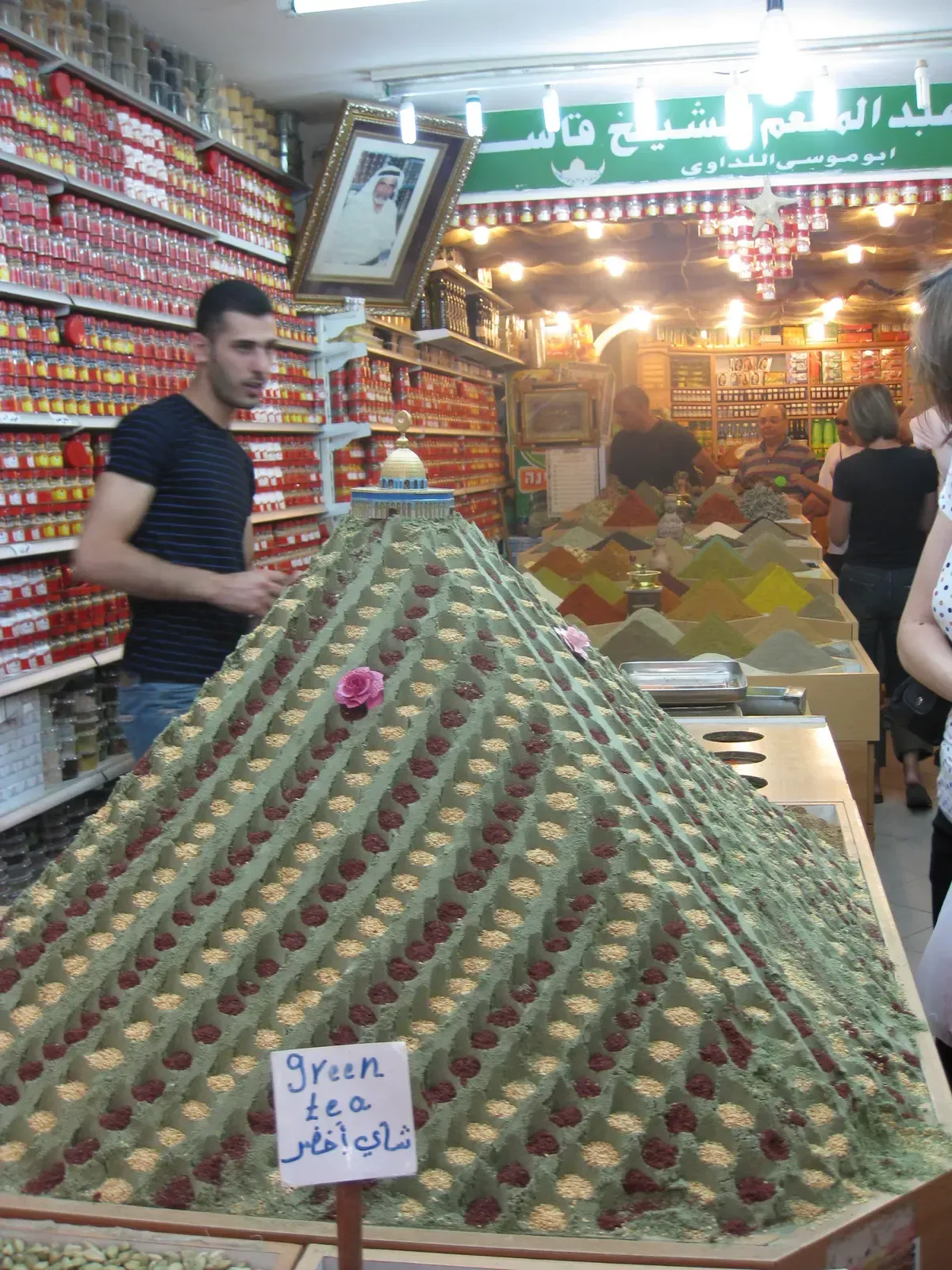
A spice stall in the covered Khan al-Zeit market street in the Muslim Quarter. Photo: Deror avi, CC BY-SA 3.0, via Wikimedia Commons
Quick answer The four quarters at a glance
Jerusalem's Old City is divided into four quarters: the Muslim Quarter in the northeast, the Christian Quarter in the northwest, the Jewish Quarter in the southeast and the Armenian Quarter, the smallest. They fill a walled area of 0.9 square kilometres (0.35 sq mi). In 2020 the Muslim Quarter had about 21,850 residents, the Christian Quarter 3,870, and the Jewish Quarter 3,240.
Key takeaways
- See sizes, populations and main sights for all four in the quarters at a glance table.
- The Christian Quarter holds about 40 holy sites around the Church of the Holy Sepulchre, described in the Church of the Holy Sepulchre guide.
- The Muslim Quarter is the largest, covering 31 hectares, and holds the first seven Via Dolorosa stations.
- Want all four quarters in one walk? A private four quarters tour of the Old City runs five hours for $500 per group.
The Quarters at a Glance
The Old City has been a UNESCO World Heritage site since 1981 and was listed as endangered in 1982. The present walls, built under Sultan Suleiman the Magnificent between 1535 and 1542 by the Old City article's dating, run about 4.5 km, stand 5 to 15 m high and carry 35 towers. Here is how the space inside them is split.
Sizes, Populations and Main Sights
The table pulls its figures from the Old City and quarter articles. Population counts are for 2020. Note the imbalance: the Muslim Quarter is both the largest and by far the most populous, while the Armenian Quarter holds about 14% of the Old City's area. The Via Dolorosa starts in the Muslim Quarter and ends in the Christian Quarter.
For navigation, the Jerusalem Old City map page shows the layout street by street.
| Quarter | Where | Size | Main sights |
|---|---|---|---|
| Muslim | Northeast, from Lions' Gate along the north wall of the Temple Mount to Damascus Gate | 31 hectares (77 acres), the largest. About 21,850 residents in 2020 | Via Dolorosa stations 1 to 7, St Anne and the Pools of Bethesda, Zedekiah's Cave, the Cotton Merchants' Market |
| Christian | Northwest, centred on the Church of the Holy Sepulchre | About 3,870 residents in 2020 | Church of the Holy Sepulchre, Church of the Redeemer, Muristan, Christian Quarter Road, about 40 holy sites |
| Jewish | Southeast | About 28 to 29 acres. About 3,240 residents in 2020 | Western Wall, Cardo, Hurva Synagogue, Wohl Archaeological Museum, full guide |
| Armenian | Reached through Zion Gate and Jaffa Gate | 0.126 km2 (126 dunams), about 14% of the Old City | Cathedral of St James, St Toros Manuscript Library with 3,890 manuscripts, Gulbenkian Library, full guide |
How the Quarters Connect
Seven gates are in use today. Just inside Jaffa Gate a plaza leads to the Christian Quarter on the left, the Muslim Quarter ahead and the Armenian Quarter on the right by the Tower of David. Damascus Gate, built in 1537, opens onto the bazaar of the Muslim Quarter and is the only gate where steps lead down into the city. New Gate, built between 1887 and 1889, links the Christian Quarter with West Jerusalem and stands at about 790 m above sea level, the highest point of the walls. Lions' Gate in the north-eastern wall is where Christians traditionally enter to walk the Via Dolorosa. Dung Gate, widened in 1952 and again in 1984 and 1985 to a 4.5 m opening, is the access point for buses to the Western Wall. The sealed Golden Gate is the eighth named gate, and the sealed Huldah Gates are in the southern wall of the Temple Mount.
If you would rather not navigate alone, several guided walks thread all four quarters in one route. The Jerusalem Old City Half-Day Tour covers the Jewish, Christian, Muslim and Armenian quarters in 3 hours for $39 per person, and the Jerusalem Old City Tour from Tel Aviv does so on a 10.5-hour day for $90 per person.
Sources: Western Wall Heritage Foundation, Christian Information Center opening hours, Jerusalem tourism office
The Christian Quarter
The Christian Quarter fills the northwest of the Old City and holds about 40 holy sites. Most visits start and end at the Church of the Holy Sepulchre, but the quarter rewards an extra hour along its shopping streets and at its viewpoints.
The Church of the Holy Sepulchre
The Church of the Holy Sepulchre is the quarter's centre of gravity and the destination of the Via Dolorosa. The last five stations of the Cross are in or beside it. Hours, the rotating custodianship and practical visiting advice are covered in full in the Church of the Holy Sepulchre guide, so this page stays on the quarter around it.
The Christian Information Center faces the Tower of David Museum and provides mass times, tours and pilgrimage site guidance. It is open 9:00 to 16:00, until 15:30 on Friday, and closed Saturday. The Franciscan Pilgrims' Office at Jaffa Gate is open Monday to Friday 9:00 to 13:00. If you want the church explained rather than visited cold, the Jerusalem Old City Walking Tour includes it on a 4-hour route from Jaffa Gate for $57 per person.
The Church of the Redeemer and Its Tower
The Church of the Redeemer was built in the 1890s on land given to the Prussian king after the 1869 opening of the Suez Canal, and dedicated on Reformation Day 1898 by Kaiser Wilhelm II. A plaque on the site marks the Knights Hospitaller's first hospital.
Check the hours before you plan around the climb, because sources disagree. The Christian Information Center's hours list gives the church and tower as open Tuesday to Thursday and Saturday 10:00 to 14:00, and other listings differ. The same list gives ₪7.50 for the tower and museum, and other listings give different fees. Step counts for the tower also differ between sources, so expect about 180 steps and do not rely on an exact number. Under the church, the Durch die Zeiten archaeological park opened in 2012.
Shopping Streets, the Muristan and Viewpoints
David Street and Christian Quarter Road are the quarter's main shopping routes. The Muristan is a Persian word for hospital, and a hospital stood there from around AD 600. The Mosque of Omar there was built in 1216, and the western part of the Muristan is the Suq Aftimos market with a fountain. Casa Nova is one of the pilgrim hotels in the quarter.
For a paid view and a fixed programme, the Christian Information Center lists a rooftop viewpoint at ₪5 and an Experience of Resurrection show at ₪35, shown at 9:30 and 15:15. Closer to Jaffa Gate, Christ Church, consecrated on 21 January 1849, is the oldest Protestant church building in the Middle East. It is closed Monday, Tuesday and Saturday and open Wednesday to Friday and Sunday 9:00 to 15:00. The Church of St Alexander Nevsky is open 9:00 to 18:00 with a ₪5 entrance fee.
The Muslim Quarter
The Muslim Quarter is the largest of the four, covering 31 hectares (77 acres) in the northeast of the Old City. It stretches from Lions' Gate along the north wall of the Temple Mount to Damascus Gate, and had about 21,850 residents in 2020.
Markets and Streets
Enter through Damascus Gate and you arrive directly in the quarter's bazaar. The gate was built in its present form in 1537 under Suleiman and sits on a Roman gate from around 129 to 130 CE. Note that the Christian Information Center's list says that excavation is open to pre-booked groups only. Herod's Gate, given its current form in 1875, connects the quarter with the Bab az-Zahra neighbourhood outside the walls.
The Cotton Merchants' Market was rebuilt in 1336 by the Mamluk emir Tankiz. The Via Dolorosa guide walks the route station by station. To see the quarter with a guide and the two readings of its history, the Jerusalem Dual Narrative Tour runs 4.5 hours for $65 per person with groups capped at 20.
St Anne and the Pools of Bethesda
The Basilica of St Anne and the Pools of Bethesda are in the Muslim Quarter. Entry costs ₪12 for adults and ₪10 for students. The site is open Monday to Saturday 8:00 to 12:00 and 14:00 to 16:00, and closed on Sunday. The St Anne museum inside is open on a narrower schedule, Tuesday, Thursday and Saturday 9:00 to 12:00 and 14:00 to 16:00.
If you are on a Christian-route day tour, this site appears on the Footsteps of Jesus Walking Tour, a 9-hour day with hotel pickup for $89 per person, but note that entrance fees are not included on that tour.
Zedekiah's Cave and the Garden Tomb
Two further sites are worth knowing. Zedekiah's Cave, also called Solomon's Quarries, runs between Damascus Gate and Herod's Gate. It is open Sunday to Thursday 9:00 to 17:00 in summer and 9:00 to 16:00 in winter, and closed on Friday and Saturday. Entry is ₪25 self-guided, or ₪12 for children, students and seniors. An audio-visual show costs ₪40 or ₪30 and runs Sunday to Thursday at 16:00 by reservation, with visitors asked to arrive 15 minutes early.
Outside Damascus Gate, the Garden Tomb is open Monday to Thursday and Saturday 9:00 to 13:00, and closed Friday and Sunday. Lions' Gate, built in 1538 and 1539, stands about 13.7 m tall and carries four animal carvings that historians read as leopards of the Mamluk sultan Baibars, though the gate's name says lions. Christians call it St Stephen's Gate, and the Via Dolorosa is traditionally entered from it.
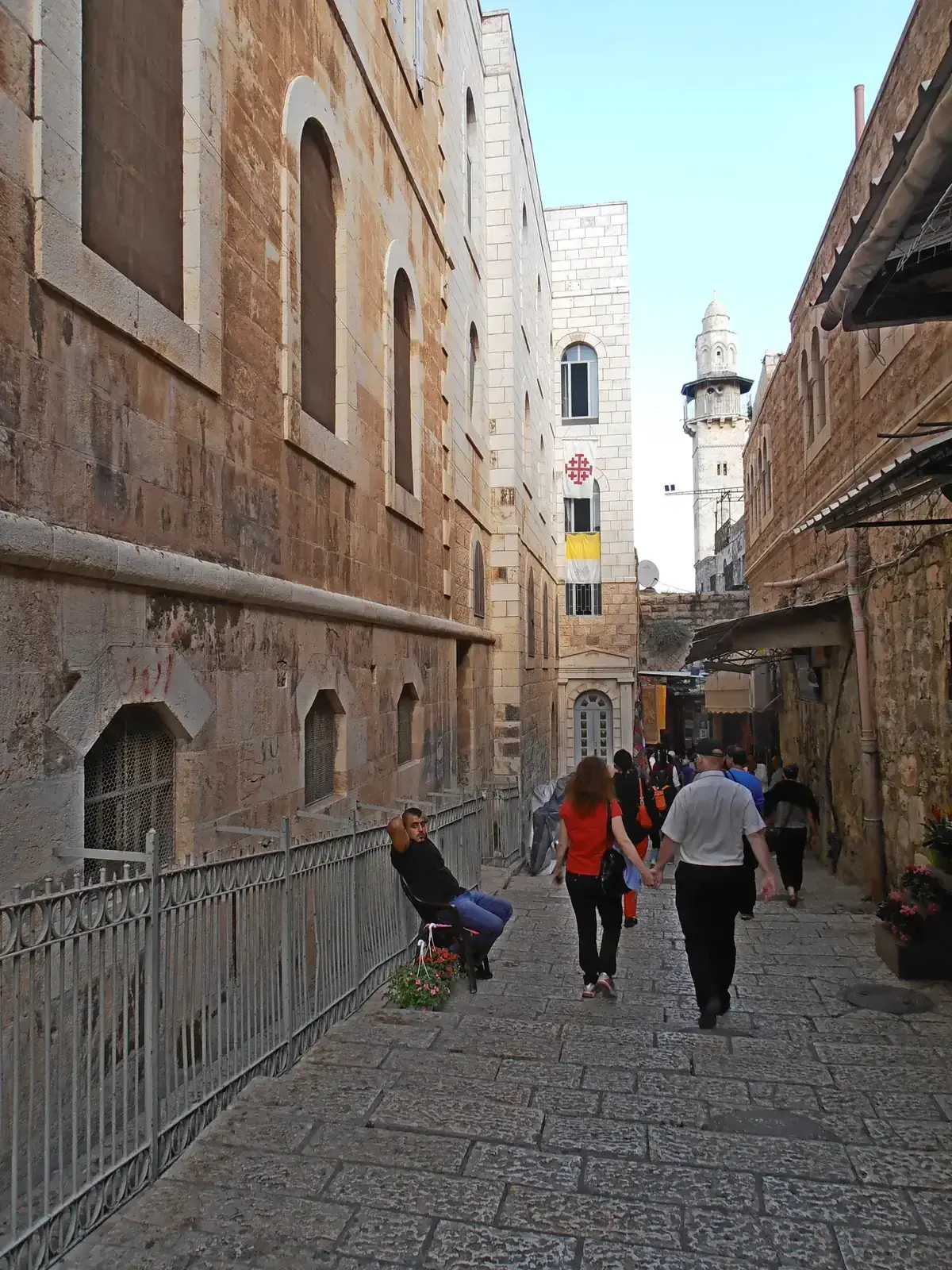
A stone street in the Christian Quarter with church buildings and a minaret in the distance. Photo: ekeidar, CC BY-SA 3.0, via Wikimedia Commons
The Jewish and Armenian Quarters in Brief
Both of these quarters have pages of their own on this site, so here is only the short version. The two links below carry the full detail on sights, hours and routes.
The Jewish Quarter in Brief
The Jewish Quarter covers roughly 28 to 29 acres in the southeast of the Old City and had about 3,240 residents in 2020. Post-1967 digs led by Nahman Avigad from 1969 uncovered the Burnt House, the Broad Wall, the Herodian Quarter, the Israelite Tower, the Byzantine Cardo and the Nea Church. The Cardo was laid out around 120 to 130 CE and extended by Justinian in the 6th century. It was about 22.5 m wide with a 12 m central roadway, and its original pavement lies several metres below the present Jewish Quarter Street.
The Hurva Synagogue was built in 1864, destroyed on 27 May 1948 and reopened on 15 March 2010 after a five-year rebuild. The rebuilt hall holds about 250 worshippers against 450 in the original. The Jerusalem Archaeological Park and Davidson Center charges ₪40 for adults and ₪22 for children, students, soldiers and Israeli seniors, and a guided tour there costs ₪55 per adult and ₪45 per child with entrance included. For the full sight list, hours and how to reach the Western Wall, read the Jewish Quarter Jerusalem guide.
The Armenian Quarter in Brief
The Armenian Quarter is the smallest of the four, at 0.126 km2 or about 14 percent of the Old City. Armenian settlement here dates to the 4th century, and the community is described as the oldest living diaspora community outside Armenia. The Armenian Patriarchate gained formal patriarchal status in 1311. You reach the quarter through Zion Gate, built in July 1540, or Jaffa Gate.
Its key sights run on tight hours. The Cathedral of St James, complete by the 12th century and holding ceramic eggs made in Kutahya, opens Monday to Friday and Sunday 6:30 to 7:30, Saturday 6:30 to 10:00, and daily 15:00 to 15:30. The Armenian Museum is open Tuesday to Saturday 9:00 to 16:00 and closed Sunday and Monday. The Gulbenkian Library, opened in 1932, holds about 100,000 volumes, and the St Toros Manuscript Library founded in 1897 holds 3,890 catalogued manuscripts. The Armenian Quarter Jerusalem guide has the rest.
Crossing All Four in One Walk
The whole Old City is 0.9 square kilometres, so a single walk can cover all four quarters in a few hours. Here is a route built from the gates, streets and sites, plus the guided options that do the same job.
A DIY Route Through the Quarters
Start at Jaffa Gate, whose Ottoman gate dates from 1538 and whose plaza leads to the Christian Quarter on the left, the Muslim Quarter ahead and the Armenian Quarter on the right by the Tower of David. David Street is one of the Christian Quarter's two main shopping routes, and the Church of the Holy Sepulchre is the quarter's anchor among its about 40 holy sites. The Muristan, a Persian word for hospital where a hospital stood from around AD 600, is also in the quarter, and the Mosque of Omar there was built in 1216.
The Armenian Quarter is reached through Zion Gate or Jaffa Gate. The Muslim Quarter holds the first seven Stations of the Cross of the Via Dolorosa, which ends at the Church of the Holy Sepulchre. The Jewish Quarter holds the Western Wall, the Cardo and the Hurva Synagogue, and Zion Gate was built in July 1540. The walls run about 4.5 km around all of this, standing 5 to 15 m high with 35 towers, and were built by Suleiman the Magnificent, with construction dates given as 1535 to 1542 in one source and 1533 to 1540 in another.
| Stop | Quarter | Figure |
|---|---|---|
| Jaffa Gate | Armenian edge | Ottoman gate of 1538 |
| Church of the Holy Sepulchre | Christian | About 40 holy sites in the quarter |
| Via Dolorosa | Muslim | First seven Stations of the Cross here |
| Western Wall | Jewish edge | Dung Gate is the access point for buses, widened to 4.5 m in 1984 and 1985 |
| Zion Gate | Armenian edge | Built in July 1540 |
Guided Options That Cover All Four
Several tours on this site list all four quarters in their coverage, and they differ sharply in price and format. The cheapest is the 3-hour Jerusalem Old City Half-Day Tour at $39 per person with groups capped at 25, meeting at the David Citadel Hotel. The 10.5-hour Jerusalem Old City Tour from Tel Aviv at $90 per person includes round-trip transport and a 3.5-hour guided walk through all four quarters with an hour of free time for lunch. Entry fees are not listed as included on either.
For a private format, the Private Old City Four Quarters Tour costs $500 per group, not per person, for 5 hours, and landing and facility fees are not included. If you want the two readings of the city's history instead, the Jerusalem Dual Narrative Tour at $65 per person runs 4.5 hours with a Jewish Israeli and a Palestinian guide and groups capped at 20. Compare times, durations and meeting points before booking.
| Tour | Price | Duration | Format |
|---|---|---|---|
| Old City Half-Day Tour | $39 per person | 3 hours | Group up to 25 |
| Old City Tour from Tel Aviv | $90 per person | 10.5 hours | Transport included |
| Four Quarters Private Tour | $500 per group | 5 hours | Private |
| Dual Narrative Tour | $65 per person | 4.5 hours | Two guides, up to 20 |
Tips for Walking the Four Quarters
Do
- Do start at Jaffa Gate because its plaza is the natural pivot point, with the Christian Quarter on the left, the Muslim Quarter ahead and the Armenian Quarter on the right.
- Do check opening hours before each site because they vary widely, for example St Anne and the Pools of Bethesda close Sundays and the Armenian Museum closes Sunday and Monday.
- Do budget for small fees because several sites charge entry, such as ₪5 at the Church of St Alexander Nevsky and ₪12 for adults at the Basilica of St Anne.
- Do use the New Gate for a fast exit to West Jerusalem because it is the quickest way from the Old City to West Jerusalem.
- Do use Dung Gate for buses to the Western Wall because it is the access point for them and the main vehicle exit from the Old City.
Don't
- Don't plan your visit to Zedekiah's Cave on Friday or Saturday because it is closed those days, opening Sunday to Thursday 9:00 to 17:00 in summer and 9:00 to 16:00 in winter.
- Don't count on entry to the Golden Gate because it is sealed, as are the Single, Double and Triple Gates in the southern wall of the Temple Mount.
- Don't assume the Garden Tomb is open every day because it opens Monday to Thursday and Saturday 9:00 to 13:00 and closes Friday and Sunday.
- Don't expect to drive into the quarters freely because the Jaffa Gate vehicle checkpoint runs Sunday to Thursday 9:00 to 18:00 and Friday and holiday eves 9:00 to 13:00, admitting only approved vehicles such as shuttles up to 24 seats.
FAQ
What are the four quarters of Jerusalem's Old City?
The Muslim Quarter in the northeast, the Christian Quarter in the northwest, the Jewish Quarter in the southeast and the Armenian Quarter, the smallest. The whole walled area is 0.9 square kilometres, and you can see how it splits up on the Jerusalem Old City map.
Which quarter is the largest?
The Muslim Quarter, at 31 hectares or 77 acres, with about 21,850 residents in 2020. It runs from Lions' Gate along the north wall of the Temple Mount to Damascus Gate, as covered in the Muslim Quarter section of this guide.
How many people live in each quarter?
In 2020 the counts were about 21,850 in the Muslim Quarter, 3,870 in the Christian Quarter, and 3,240 in the Jewish Quarter. Sources differ on the Armenian Quarter, so no figure is given. The Christian Quarter is the second largest by residents.
Can you walk between the quarters easily?
Yes, a 3-hour walk can cover all of them, as on the Old City Half-Day Tour. Jaffa Gate alone gives access to three of them from one plaza.
Which gates serve the different quarters?
New Gate serves the Christian Quarter, Damascus Gate opens onto the Muslim Quarter's bazaar, Herod's Gate connects the Muslim Quarter with Bab az-Zahra outside, Lions' Gate is the traditional entry for the Via Dolorosa, Zion Gate leads to the Jewish and Armenian quarters and Dung Gate is the access point for the Western Wall buses. The gates of Jerusalem Old City guide lists all seven in use today.
Is there a tour that covers all four quarters with one guide?
Yes, the private four quarters tour costs $500 per group for 5 hours and covers the Jewish, Christian, Muslim and Armenian quarters with a private guide meeting you just outside Jaffa Gate. Landing and facility fees are not included, and the Private Old City Four Quarters Tour page has the full listing.