 Jerusalem Old City Tour
The Church of the Holy Sepulchre: A Visitor's Guide
The Church of the Holy Sepulchre stands in the heart of the Christian Quarter of Jerusalem's Old City, and it holds the spots where tradition places the crucifixion and the burial of Jesus. Entry is generally free, the church opens at 5:00 in summer and 4:00 in winter, and a daily procession moves through the building each afternoon. This guide covers the hours by season, what to expect at the door, and every major stop inside in the order you will walk it. If you would rather see it with a guide, the comparison of Jerusalem Old City tours on Old City Jerusalem tours lists the walks that include it.
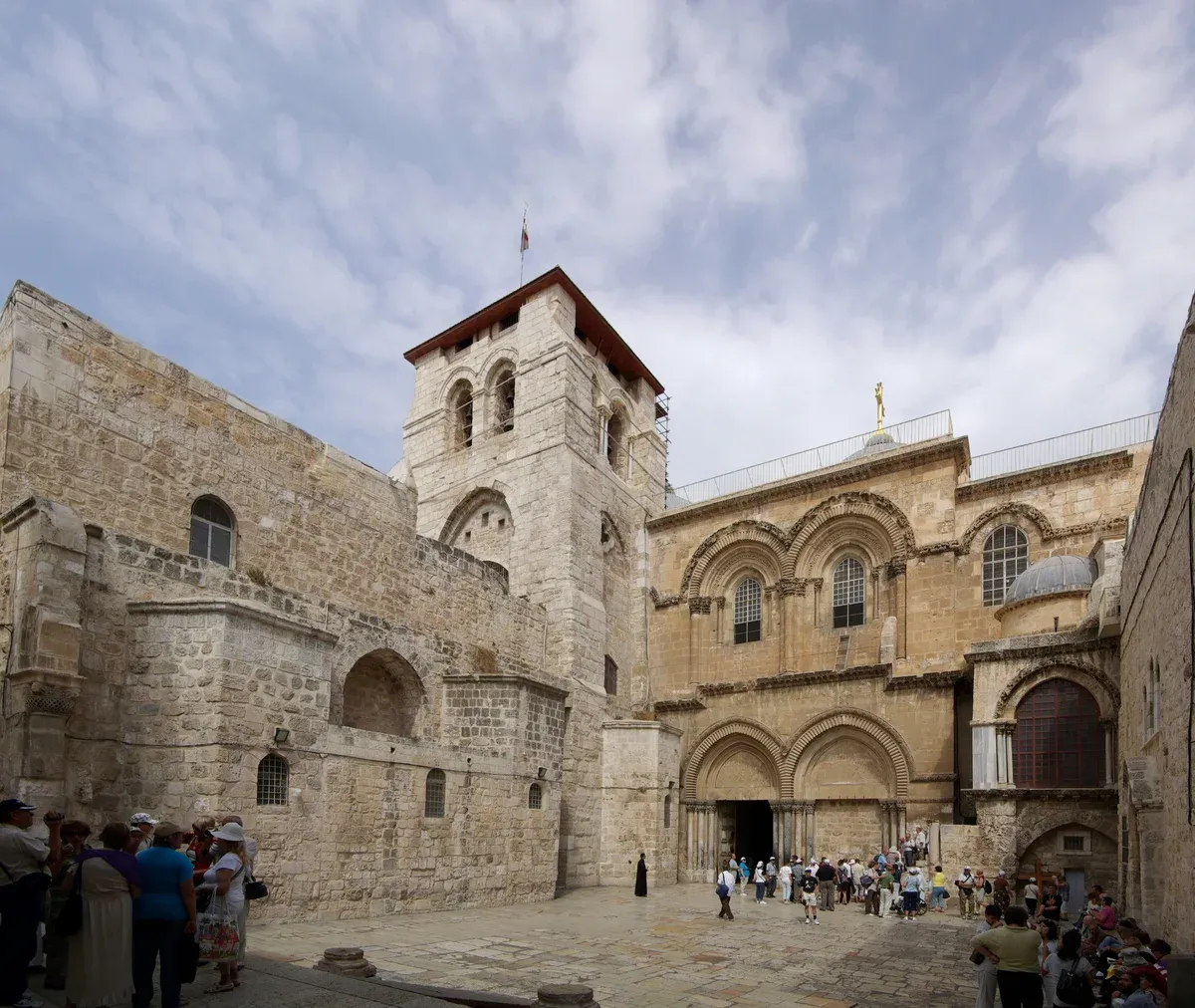
The stone facade and forecourt of the Church of the Holy Sepulchre in the Christian Quarter. Photo: Berthold Werner, CC BY-SA 3.0, via Wikimedia Commons
Quick answer Hours, entry and the essentials
Entry to the Church of the Holy Sepulchre is generally free, and the church opens 5:00 to 20:45 in summer and 4:00 to 19:00 in winter. It stands in the Christian Quarter, and the last five Stations of the Cross are in or beside it.
Key takeaways
- Hours change with the seasons: summer 5:00 to 20:45, winter 4:00 to 19:00, with closing times of 20:00 in October and 19:30 in March. Details in the hours and entry section.
- The building holds the Stone of Unction, Calvary and the Aedicule over the tomb. Walk it stop by stop in inside the church.
- Six denominations share the church under the Status Quo, and two Muslim families hold the keys.
- Short on time? The Jerusalem Old City Walking Tour covers the church in a 4-hour walk from Jaffa Gate for $57 per person, and the Jerusalem Half Day Tour reaches it with hotel pickup and entrance fees included for $50.
Visiting the Church: Hours, Entry and Timing
The practical side first: when the doors open, what entry costs and how the daily procession fits into your plan.
Hours, Entry and the Daily Procession
The Christian Information Center's hours list for the holy places gives the church's opening times in two seasons, and entry is generally free. The daily procession starts in the late afternoon, so plan around it if you want to see it or avoid it. The church's phone number in the same list is 02 626 7011 if you need to confirm a time before you go.
The table below collects the figures in one place, from the Christian Information Center list and the city's tourism portal.
| What | Detail |
|---|---|
| Summer opening hours | 5:00 to 20:45, closing at 20:00 in October |
| Winter opening hours | 4:00 to 19:00, closing at 19:30 in March |
| Entry fee | Generally free |
| Daily procession | 17:00 in summer, 16:00 in winter |
| Nearest gate | The church stands in the Christian Quarter |
| Phone | 02 626 7011 |
When to Go and How Long to Allow
The doors open at 5:00 in summer and 4:00 in winter, and the daily procession at 17:00 in summer and 16:00 in winter is a fixed point in the day. Allow enough time for the Calvary stairway, the Aedicule and the lower chapels.
The hours list gives no dress code for the Church of the Holy Sepulchre or for any other holy place in Jerusalem, and no queue times at the Aedicule appear on any official page. Entry is free, so there is no ticket to buy and no counter to find.
If you want the church explained as you walk it, several bookable routes include it. The Jerusalem Old City Walking Tour spends a 4-hour route from Jaffa Gate at $57 per person taking in the Via Dolorosa and the Holy Sepulchre. The cheaper Jerusalem Old City Half-Day Tour does the same circuit in 3 hours for $39 per person with groups capped at 25. A wider choice of Jerusalem Old City tours is compared on the homepage.
Sources: Western Wall Heritage Foundation, Christian Information Center opening hours, Jerusalem tourism office
Inside the Church, Stop by Stop
One door leads into a building that holds the last five Stations of the Cross, Calvary and the tomb. Here is the order most visitors walk it.
The Entrance and the Stone of Unction
You enter from the Christian Quarter. The Stone of Unction lies just inside the entrance, and it marks the spot where, by tradition, the body of Jesus was anointed before burial. The stone in its present form dates from the 1810 reconstruction of the church, though veneration at this spot is first attested in the Crusader era.
Behind it, a modern mosaic on the wall shows three scenes in sequence: the Descent from the Cross, the anointing of the body and the burial. The Rotunda with the Aedicule and the stairway to Calvary are the next stops.
Calvary, the Rock of the Crucifixion
Calvary, the traditional site of the crucifixion, is reached by a stairway from the entrance level. The space at the top is split into two chapels, a Greek Orthodox chapel and a Catholic chapel, each with its own altar, and a Stabat Mater altar stands between them.
In the Greek Orthodox chapel the rock itself can be touched through a hole in the floor beneath the altar, The Catholic chapel has its own altar. The Immovable Ladder rests under a facade window and its place is fixed by the Status Quo.
The Chapel of Adam
The Chapel of Adam lies beneath Calvary. The chapel rests on an old tradition that the skull of Adam was buried on this spot, which is why the place of the skull and the place of the cross are joined in one building.
The tradition links the skull of Adam to the place of the crucifixion above.
The Rotunda and the Aedicule
The Rotunda is the wide, domed hall at the heart of the church, and at its centre stands the Aedicule, the structure that encloses the traditional burial place of Jesus. No official page states queue times at the Aedicule.
The Aedicule you see today is the result of a restoration carried out in 2016 to 2017. The work exposed the original limestone cave walls. The daily procession starts at 17:00 in summer and 16:00 in winter.
The Chapel of St Helena
The Chapel of St Helena is on a lower level of the church, reached through Crusader-era excavations.
The Crusader rebuilding, completed in 1149 under Queen Melisende, brought the chapels under one roof. On the roof above the chapel sits the Ethiopian monastery of Deir es-Sultan, which covers about 1,800 square metres and has its own long story of shared claims, told in the next stop.
Deir Es-Sultan, the Ethiopian Monastery on the Roof
Deir es-Sultan, the Ethiopian monastery, occupies about 1,800 square metres on the roof above the Chapel of St Helena.
The site carries a long shared-history question. Ethiopian monks were first hosted there by the Copts in 1654, and both the Coptic and Ethiopian churches claim the monastery to this day. The Status Quo agreements of 1757 and 1853 fixed rights across the building.
Six Churches Under One Roof
The Church of the Holy Sepulchre is shared, not owned by one church. Who lights which lamp, repairs which roof tile and holds which key is all fixed by agreement.
The Status Quo
Six Christian denominations share the church under an arrangement known as the Status Quo. Its roots are agreements of 1757 and 1853, and the rights they fixed still govern daily life inside the building. Three communities hold the main shares: the Greek Orthodox, the Roman Catholic (Latin) and the Armenian Apostolic.
The famous case is the Immovable Ladder, which rests under a facade window. Its place is fixed by the Status Quo.
- Greek Orthodox, Armenian Apostolic and Latin Catholic communities hold the main rights under agreements of 1757 and 1853.
- The Coptic and Ethiopian churches both claim the monastery of Deir es-Sultan on the roof.
- The Immovable Ladder under a facade window cannot be moved because of the Status Quo.
- The Ethiopian monastery of Deir es-Sultan covers about 1,800 square metres on the roof above the Chapel of St Helena.
Who Holds the Keys
The Nusseibeh and Joudeh Muslim families hold the church keys. One source dates this to Saladin's era in 1187 and the city's tourism portal dates it to the 13th century.
For the current hours and the daily procession times, see the visiting section above in this guide, and for the streets around it see the page on the four quarters of Jerusalem.
Sources: Wikipedia on the Church of the Holy Sepulchre and Deir es-Sultan, the city tourism portal.
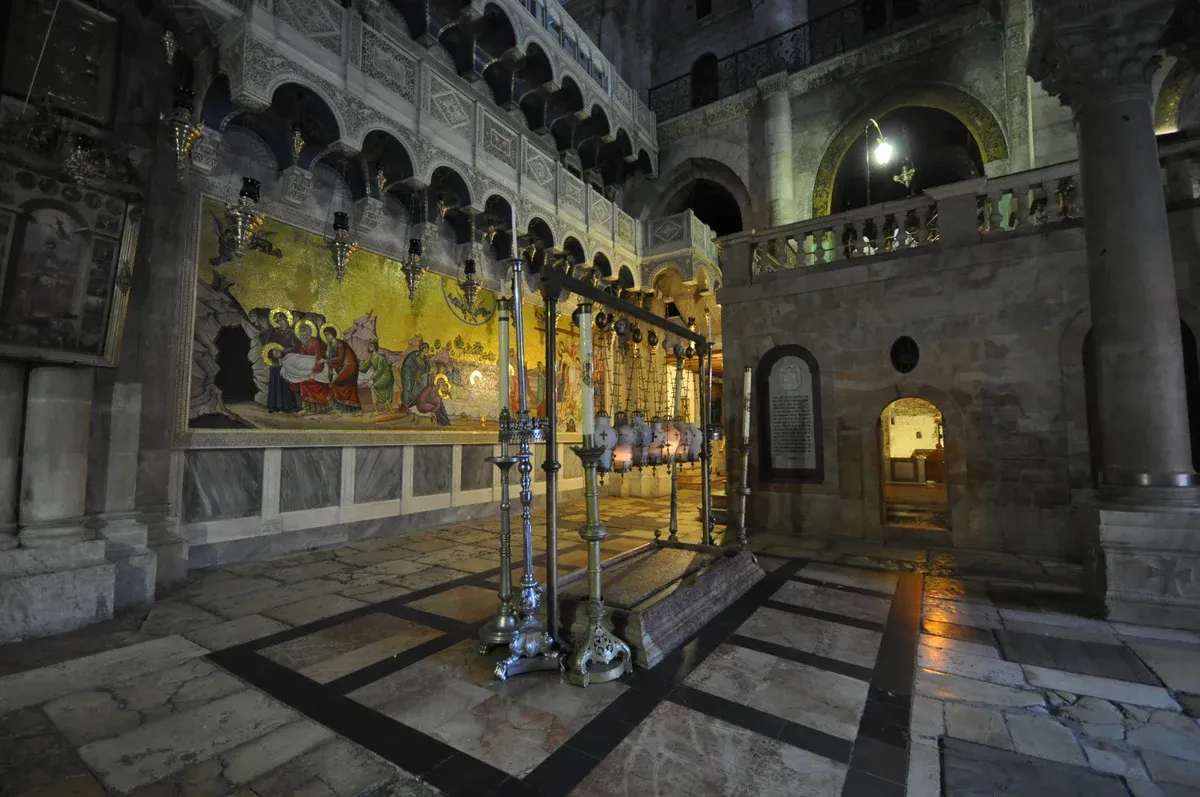
The Stone of Anointing and the mosaic behind it, just inside the church entrance. Photo: Jorge Láscar from Australia, CC BY 2.0, via Wikimedia Commons
A Short History of the Church
Each layer of the building explains something you will see inside.
From Constantine to the Crusaders
Constantine's church was built between 326 and 335 CE. That first church was destroyed in 1009 by the Fatimid caliph al-Hakim. The Crusaders then rebuilt and unified the shrines under one roof, completing the work in 1149 under Queen Melisende. The Crusader rebuilding brought a bell tower and the chapels together in a single building.
The next great change came from fire. A major fire hit the church in 1808, and the reconstruction that followed gave the Stone of Unction the form you see just inside the entrance. Veneration at that spot is first attested in the Crusader era, but the stone slab itself dates from the 1810 reconstruction. The wall mosaic behind it, showing the Descent from the Cross, the anointing and the burial, is modern.
The Aedicule Restoration
The Aedicule, the shrine inside the Rotunda that encloses the traditional burial place, was restored in 2016 to 2017. The work exposed the original limestone cave walls of the tomb.
The table below gathers the key dates, from the first building under Constantine to the modern restoration of the tomb shrine.
| Year | What happened |
|---|---|
| 326-335 CE | Constantine's church built over Calvary and the tomb |
| 1009 | The church destroyed by al-Hakim |
| 1149 | Crusaders unify the shrines under one roof under Queen Melisende |
| 1187 | Date one source gives for the Nusseibeh and Joudeh Muslim families holding the keys. Another source says the 13th century |
| 1757 | Agreement fixing rights, later confirmed in 1853 |
| 1808 | Major fire hits the church |
| 1810 | Reconstruction gives the Stone of Unction its present form |
| 2016-2017 | The Aedicule restored, exposing the original limestone cave walls |
Sources: Wikipedia on the Church of the Holy Sepulchre and the Stone of Anointing.
Seeing It With a Guide
Entry is free, so you do not need a ticket. What a guide adds is the order to walk it and the story behind each chapel, and the walking tours on this site that include the church are listed below.
Old City Walking Tours That Enter the Church
The tours below all list the Church of the Holy Sepulchre among the sites they enter. Entry fees are not included on the walk-only tours, which costs nothing here because the church itself is free.
The pick for a first visit is the Jerusalem Old City Walking Tour: $57 per person, 4 hours from Jaffa Gate through the quarters, the Western Wall and the Via Dolorosa to the church, rated 4.8 from 414 reviews. Food and drinks are not included. If you want the shortest option, the Jerusalem Old City Half-Day Tour covers the same Christian Quarter finish in 3 hours for $39 per person with groups capped at 25. A private alternative is the Private Jerusalem Holy City Tour at $190 per person for 3 to 5 hours with a hotel meet-up in central Jerusalem, ending near Jaffa Gate.
From Tel Aviv, the Jerusalem Old City Tour from Tel Aviv ($90 per person, 10.5 hours with round-trip transport) and the Jerusalem Boutique Tour from Tel Aviv ($180 per person, 9 hours, up to 18 travellers) both enter the church. The Jerusalem and Bethlehem Tour from Tel Aviv gives about 2.5 hours in the Old City for $121 per person and lists entrance fees as included. The Jerusalem Half Day Tour combines the church with the Western Wall for $50 per person, hotel pickup included, and ends in the Old City about 13:00 so you plan your own way back.
The Stations of the Cross along the route belong to the Via Dolorosa page. For the full comparison of every option, see Jerusalem Old City tours on the homepage.
| Tour | Price | Duration | Church entered |
|---|---|---|---|
| Old City Walking Tour | $57 per person | 4 hours | Yes |
| Old City Half-Day Tour | $39 per person | 3 hours | Yes |
| Private Holy City Tour | $190 per person | 3-5 hours | Yes |
| Old City Tour from Tel Aviv | $90 per person | 10.5 hours | Yes |
| Boutique Tour from Tel Aviv | $180 per person | 9 hours | Yes |
| Jerusalem and Bethlehem from Tel Aviv | $121 per person | 10 hours | Yes, entrance fees included |
| Half Day Holy Sepulchre and Western Wall | $50 per person | Half day, ends about 13:00 | Yes, entrance fees included |
Sources: tour operator listings as summarised in this guide's comparison.
Tips for Visiting
None of these come from a dress code, because no official dress code for the church is published. They come from the published hours, the church's layout and how the communities share it.
Do
- Do time your visit around the daily procession, which starts at 17:00 in summer and 16:00 in winter, because it is the one fixed ritual that happens every day.
- Do use the summer or winter hours as your base plan, 5:00 to 20:45 in summer and 4:00 to 19:00 in winter, then check by phone on 02 626 7011 before you set out.
- Do enter with a plan, because the Stone of Unction, the Calvary stairway, the Rotunda and the Aedicule follow an order and knowing it saves you a second lap.
- Do look up at the facade before you go in, because the Immovable Ladder under the facade window is fixed in place by the Status Quo.
- Do leave time for the lower level, because the Chapel of St Helena is reached through Crusader-era excavations and the Chapel of Adam sits beneath Calvary.
Don't
- Don't touch or move anything in the shared areas, because the Status Quo forbids changes to common spaces without the consent of all communities.
- Don't arrive in October or March without checking the closing time, because the church closes at 20:00 in October and 19:30 in March rather than the standard seasonal hours.
- Don't plan to skip the queue at the Aedicule, because there is no official statement on queue times or the best time of day, so build slack into your schedule.
- Don't assume a guide price covers everything, because most Old City walking tours list entry fees as not included even though this church is free to enter.
Frequently Asked Questions
Can you visit the actual tomb of Jesus?
You can enter the Aedicule in the Rotunda, which encloses the traditional burial place, and the 2016 to 2017 restoration exposed the original limestone cave walls. Entry to the church itself is generally free. See the visiting section in this Church of the Holy Sepulchre guide.
What is under the Church of the Holy Sepulchre?
A lower level holds the Chapel of St Helena, reached through Crusader-era excavations, and the Chapel of Adam lies beneath Calvary, resting on the tradition that Adam's skull was buried there. The Ethiopian monastery of Deir es-Sultan covers about 1,800 square metres on the roof above St Helena. More on the layout is in the guide to the four quarters of Jerusalem.
Is the Church of the Holy Sepulchre open every day?
The published hours are 5:00 to 20:45 in summer and 4:00 to 19:00 in winter, with closings of 20:00 in October and 19:30 in March. A daily procession starts at 17:00 in summer and 16:00 in winter. Season and hour details are gathered in the Jerusalem Old City map guide.
How much does it cost to enter the Church of the Holy Sepulchre?
Entry is generally free, and the city's tourism portal also lists the church as free and accessible. Costs only appear on guided tours, for example $57 per person for the 4-hour walk that ends there, and you can compare options among Jerusalem Old City tours.
Who holds the keys to the church?
The Nusseibeh and Joudeh Muslim families hold the keys. One source dates this to Saladin's era in 1187 and the city tourism portal to the 13th century. The six denominations inside share rights under the Status Quo instead. The background is in the history section of this Church of the Holy Sepulchre guide.
Which Stations of the Cross are inside the church?
The last five of the 14 stations are in or beside the church, after nine in the streets, and the city's tourism portal notes that the last stations of the Via Dolorosa fall inside it. The station-by-station walk is on the Via Dolorosa page.