 Jerusalem Old City Tour
Jewish Quarter Jerusalem: A Guide to the Quarter, the Cardo and the Hurva Synagogue
The Jewish Quarter Jerusalem covers about 28 to 29 acres in the southeast of the Old City. It had about 3,240 residents in 2020 and holds major excavations. This guide walks through its history from 1948 to the post-1967 rebuild, then through the Cardo, the Hurva Synagogue, the Ramban and Four Sephardic Synagogues, the Burnt House and the Davidson Center, and ends with what changes on Shabbat. If you would rather see it with a guide, the comparison of Jerusalem Old City tours on the homepage lists every option with price and duration.
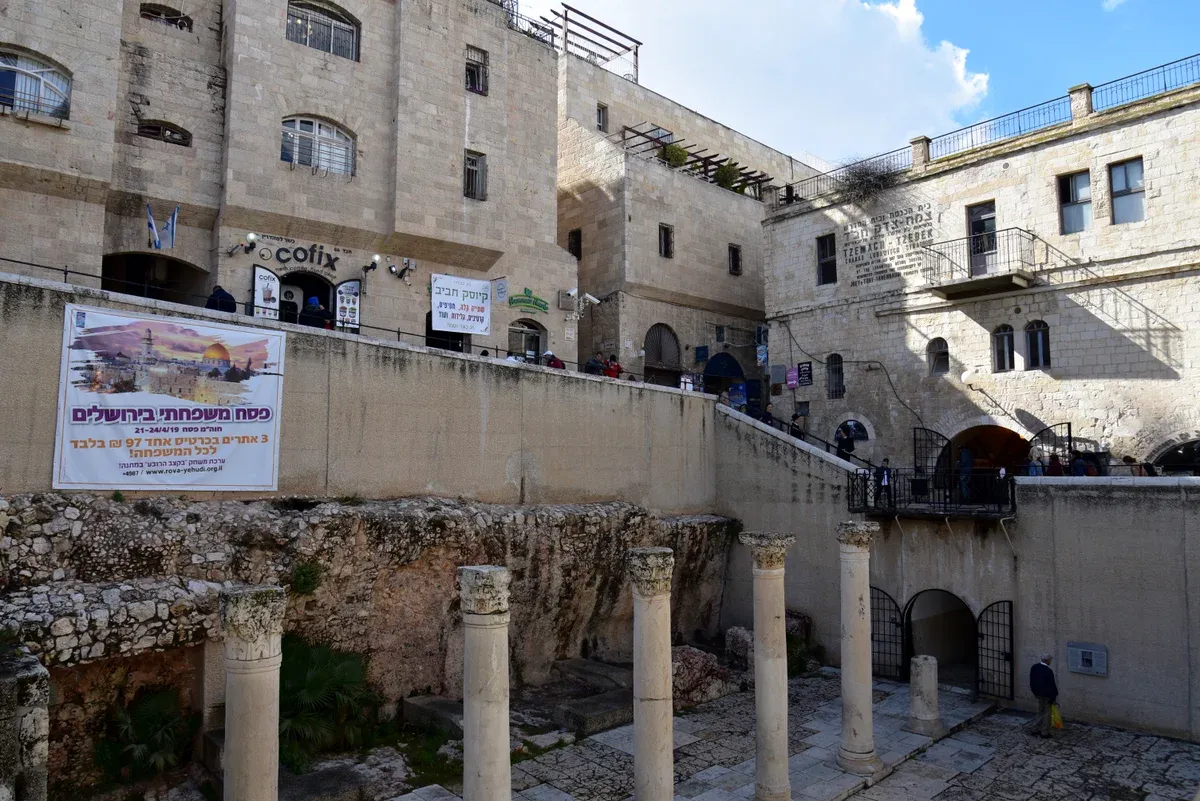
The excavated Roman Cardo Maximus with its restored columns in the Jewish Quarter. Photo: Bahnfrend, CC BY-SA 4.0, via Wikimedia Commons
Quick answer The Jewish Quarter at a glance
The Jewish Quarter Jerusalem covers roughly 28 to 29 acres in the southeast of the Old City and had about 3,240 residents in 2020. It was surrendered in 1948 and rebuilt after 1967, and its excavations turned up the Cardo and the Burnt House. the Hurva Synagogue reopened in 2010.
Key takeaways
- See the quarter as the sun goes down on the 2.5-hour Old City Shabbat Tour at $47 per person.
- Compare every Old City walking tour from Jaffa Gate in one table before you book.
- Head straight to the Davidson Center and the Southern Excavations for ticket prices in shekels.
- Plan your Friday: what opens, what closes and how to join a walk through the quarter on Shabbat.
The Quarter in Brief
A short history of the Jewish Quarter, from its 1948 surrender to the rebuild that created the sites you visit today.
Where It Sits and How Big It Is
The Jewish Quarter lies in the southeast of the Old City, and the sources give its size as roughly 28 to 29 acres. The walled Old City itself covers 0.9 square kilometres (0.35 sq mi) and is divided into four quarters. Zion Gate is on the southern wall in the Jewish Quarter, and Dung Gate, widened for vehicles in 1952 and again in 1984 and 1985 to a 4.5 m opening, is the access point for buses to the Western Wall.
The quarter had about 3,240 residents in 2020, against about 21,850 in the Muslim Quarter, and 3,870 in the Christian Quarter. Those figures come from the Old City's population counts.
1948 and What Was Lost
The Jewish Quarter surrendered on 28 May 1948. Chief Rabbi Herzog said afterwards that 22 of the Old City's 27 synagogues had been razed. The great Hurva Synagogue, built in 1864, was destroyed on 27 May 1948, and the Tiferet Yisrael Synagogue, built in 1872, was destroyed the same year.
The Batei Mahse housing complex was built between 1860 and 1890 and includes the Rothschild House of 1871.
The Rebuild After 1967
After 1967 the quarter was rebuilt on top of its own ruins. Nahman Avigad began the Jewish Quarter excavations in 1969, and the digs found the Burnt House, the Broad Wall, the Herodian Quarter, the Israelite Tower, the Byzantine Cardo and the Nea Church. By 1980 a building project had constructed 37 housing units and 35 shops around the finds.
The Broad Wall turned out to be an 8th-century BCE fortification built against the Assyrian threat of 701 BCE. If you want this whole story told on foot, the Jerusalem Old City Walking Tour covers the route from Jaffa Gate to the Western Wall in 4 hours for $57 per person, and the private Old City Four Quarters Tour runs 5 hours for $500 per group.
Sources: Wikipedia, Jewish Quarter), Wikipedia, Hurva Synagogue
Sights in the Jewish Quarter
The main sights of the quarter, what each one is and what entry costs where the sources state a price.
The Sights at a Glance
The table below gathers the quarter's main sights in one place. Entry is given only where a price is published, so read the other rows as not stated rather than free.
| Sight | What it is | Entry |
|---|---|---|
| The Cardo | Byzantine main street laid out around 120 to 130 CE and extended in the 6th century | Not stated |
| Hurva Synagogue | Rebuilt synagogue, reopened 15 March 2010 | Not stated |
| Ramban Synagogue | Synagogue dating from 1267 | Not stated |
| Four Sephardic Synagogues | A group of synagogues from the 1600s | Not stated |
| Burnt House | Priestly residence destroyed in 70 CE | Not stated |
| Wohl Archaeological Museum | Herodian mansion remains with a carved Temple menorah | Not stated |
| Broad Wall | 8th-century BCE city fortification | Not stated |
| Davidson Center | Archaeological park at the southern excavations | ₪40 adult, ₪22 child, student, soldier, senior |
The Cardo
The Cardo was laid out around 120 to 130 CE and extended by Justinian in the 6th century, and the Madaba Map shows it.
The street was about 22.5 m wide, with a 12 m central roadway and two colonnaded walks, and the columns stood 5.77 m apart. The original pavement lies several metres below the present Jewish Quarter Street, and the restored Cardo is now a shopping street and tourist site.
Among the guided tours on this site that include it: the Jerusalem Old City Tour from Tel Aviv lists Roman Cardo remnants among its stops at $90 per person for 10.5 hours, and the Private Jerusalem Holy City Tour lists the Cardo at $190 per person for 3 to 5 hours with a hotel meet-up.
Hurva Synagogue
The Hurva Synagogue is the landmark of the quarter, about 24 m to the top of its dome. The 1864 building was designed in Neo-Byzantine style by the Ottoman court architect Assad Effendi, and one source dates the original synagogue on the site to 1701. The synagogue was destroyed on 27 May 1948. A single commemorative arch stood at the site from 1977 until the rebuild, which took five years and finished on 15 March 2010.
The rebuilt hall holds about 250 worshippers, against 450 in the original. Entry prices for a visit are not stated here, so ask at the door.
Ramban Synagogue and the Four Sephardic Synagogues
The Ramban Synagogue dates from 1267.
The Four Sephardic Synagogues date from the 1600s . Neither has an entry price listed here.
Burnt House and the Excavations
The Burnt House belonged to the priestly Kathros family and was destroyed in 70 CE. It was found in the post-1967 digs.
The Wohl Archaeological Museum, also called the Herodian Quarter, holds the remains of a palatial Herodian mansion, with a carved Temple menorah. The Broad Wall, the 8th-century BCE fortification, the Israelite Tower and the Nea Church were also found in the digs. Prices and opening hours for the Burnt House and the Wohl Museum are not stated here, so confirm locally.
Zion Gate and Dung Gate
Zion Gate, built in July 1540 with the Arabic name Bab an-Nabi Dawud, is on the southern wall of the quarter. Its key was handed over on 13 May 1948 when British forces left, and the gate was restored in 2008.
Dung Gate, built between 1537 and 1541 as a pedestrian opening about 1.5 m wide, was widened for vehicles in 1952 and again in 1984 and 1985 to 4.5 m. It is the main vehicle exit from the Old City and the access point for the buses to the Western Wall, which the Foundation lists as routes 1, 2, 3 and 83. The Western Wall itself has its own guide on this site.
Sources: Wikipedia, Cardo), Wikipedia, Zion Gate
The Davidson Center and the Southern Excavations
The Davidson Center is part of the Jerusalem Archaeological Park, which holds the Herodian street and the Umayyad palaces.
What You See There
The Jerusalem Archaeological Park and Davidson Center opened in April 2001 and reopened in 2023 after renovation. Its headline find is the Herodian paved street, about 750 m long and 8 m wide, which led pilgrims to the Temple's western entrance. Benjamin Mazar's team uncovered four Umayyad palaces here, and palace number 2 once had a bridge to the Al-Aqsa Mosque.
Opening hours for the Davidson Center are not stated here, so confirm before you go.
Davidson Center Ticket Prices
The park charges ₪40 for adults and ₪22 for children, students, soldiers and Israeli seniors. A guided tour costs ₪55 per adult and ₪45 per child, with entrance included in that price.
The table below sets the two ways in side by side so you can compare them at a glance.
| Ticket | Adult | Child, student, soldier, senior |
|---|---|---|
| Entrance only | ₪40 | ₪22 |
| Guided tour, entrance included | ₪55 | ₪45 |
Going with a Guide Instead
If you want the underground Jerusalem story in one day, the City of David and Underground Jerusalem Day Tour covers the City of David, the Gihon Spring, the Pool of Siloam and the Pilgrimage Road for $89 per person over 9 hours, with entry fees, hotel pickup and drop-off included. It does not list the Davidson Center among its stops, so a visit there is a separate stop on your own day in the quarter.
Sources: iTravelJerusalem, Davidson Center, Wikipedia, Jerusalem Archaeological Park
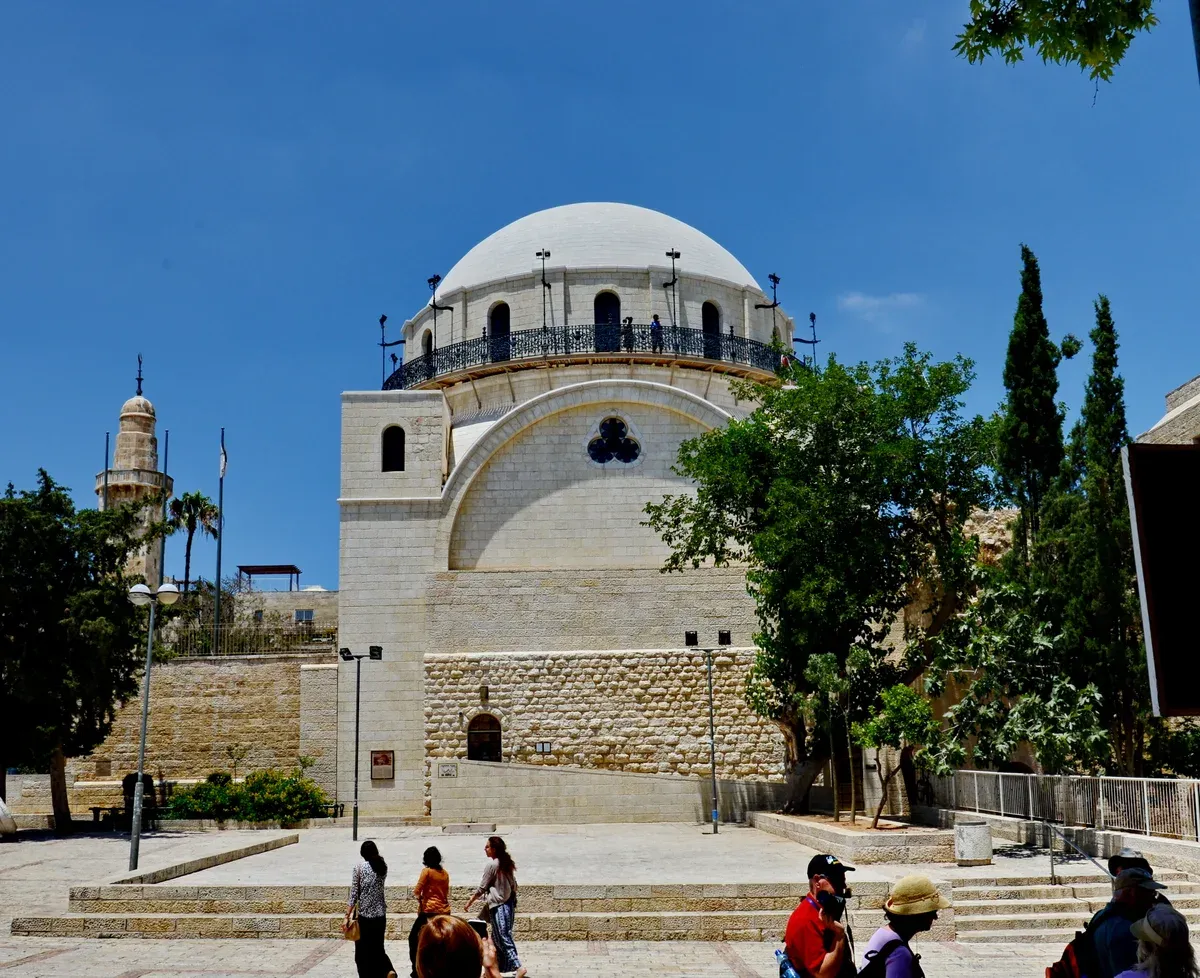
The white dome of the Hurva Synagogue on Hurva Square. Photo: אברהם גרייצר, CC BY-SA 4.0, via Wikimedia Commons
Shabbat in the Quarter
Shabbat changes the quarter's rhythm, and a guided walk is the easiest way to see it.
What Changes on Friday and Saturday
The Western Wall plaza is open all day, every day of the year. On Shabbat and Jewish holidays the Western Wall Heritage Foundation asks visitors at the plaza not to use electronic devices or amplification, not to take pictures and not to write. Eating, smoking and lighting candles are not allowed at the plaza, and the Foundation also bans alcohol, balloons, signs, sharp tools, musical instruments and animals other than guide dogs from the plaza.
The light rail does not run a daytime Shabbat service, with trains resuming after Shabbat ends, so build your return trip around that. Keep your visit simple and respectful, and check the days and hours section of the homepage comparison before you set out.
Seeing It with a Guide
The Jerusalem Old City Shabbat Tour is built around exactly this window. It runs 2.5 hours for $47 per person, meets at Jaffa Gate, and walks through Jaffa Gate, the Tower of David, the Jewish Quarter markets and the Hurva Synagogue before reaching the Western Wall as the sun prepares to set and returning to Jaffa Gate. Entry fees are not listed as included and food and drinks are not included, so it is a guided walk only.
The tour's listed quarter is the Jewish Quarter, and the route covers its markets. It is the shortest guided walk on the site's comparison table, and it carries a 4.9 rating from 10 reviews, so read those reviews as a small sample before you book.
Sources: Western Wall Heritage Foundation
Jewish Quarter Jerusalem: Questions and Answers
How big is the Jewish Quarter in Jerusalem?
The Jewish Quarter covers roughly 28 to 29 acres in the southeast of the Old City, which itself covers 0.9 square kilometres inside walls built under Suleiman the Magnificent. It had about 3,240 residents in 2020. The site's guide to the four quarters of Jerusalem sets all four side by side.
What happened to the Jewish Quarter in 1948?
The quarter surrendered on 28 May 1948, and Chief Rabbi Herzog said 22 of the Old City's 27 synagogues had been razed. The Hurva Synagogue was destroyed on 27 May 1948 and the Tiferet Yisrael Synagogue, built in 1872, was destroyed the same year. The Old City walking tour walks from Jaffa Gate to the Western Wall.
When was the Hurva Synagogue reopened?
The Hurva Synagogue was reopened on 15 March 2010 after a five-year rebuild, standing in for the 1864 building destroyed in 1948. The new hall holds about 250 worshippers against 450 in the original, and the dome rises about 24 m. The Shabbat walking tour includes the Hurva on its route.
What is the Cardo in Jerusalem?
The Cardo was the main colonnaded street of Roman and Byzantine Jerusalem, laid out around 120 to 130 CE and extended by Justinian in the 6th century. It was about 22.5 m wide with a 12 m central roadway, and part of the restored stretch is now a shopping street several metres below today's Jewish Quarter Street. The private holy city tour lists the Cardo among its stops.
How much does the Davidson Center cost?
Entrance to the Jerusalem Archaeological Park and Davidson Center costs ₪40 for adults and ₪22 for children, students, soldiers and Israeli seniors. A guided tour costs ₪55 per adult and ₪45 per child with entrance included. The full breakdown is in the Davidson Center section above.
Can you visit the Jewish Quarter on Shabbat?
You can walk through the quarter on Shabbat, but the Western Wall plaza asks visitors not to use electronic devices, take pictures or write. The Old City Shabbat Experience runs a 2.5-hour guided walk that reaches the Wall as the sun prepares to set for $47 per person, and the Western Wall guide lists the plaza rules in full.