 Jerusalem Old City Tour
The Gates of Jerusalem Old City
The gates of Jerusalem Old City are the eight openings in the Ottoman walls that ring the walled city. Seven of them are open and in daily use, and one, the Golden Gate, has been sealed for centuries. This guide covers each gate by name, in Arabic, Hebrew and English, with its build year, the quarter it serves and how traffic works around it. You will also find the story of the walls themselves, the price of walking on top of them, and which guided walks meet at which gate. The bookable tours are compared on all Jerusalem Old City tours.
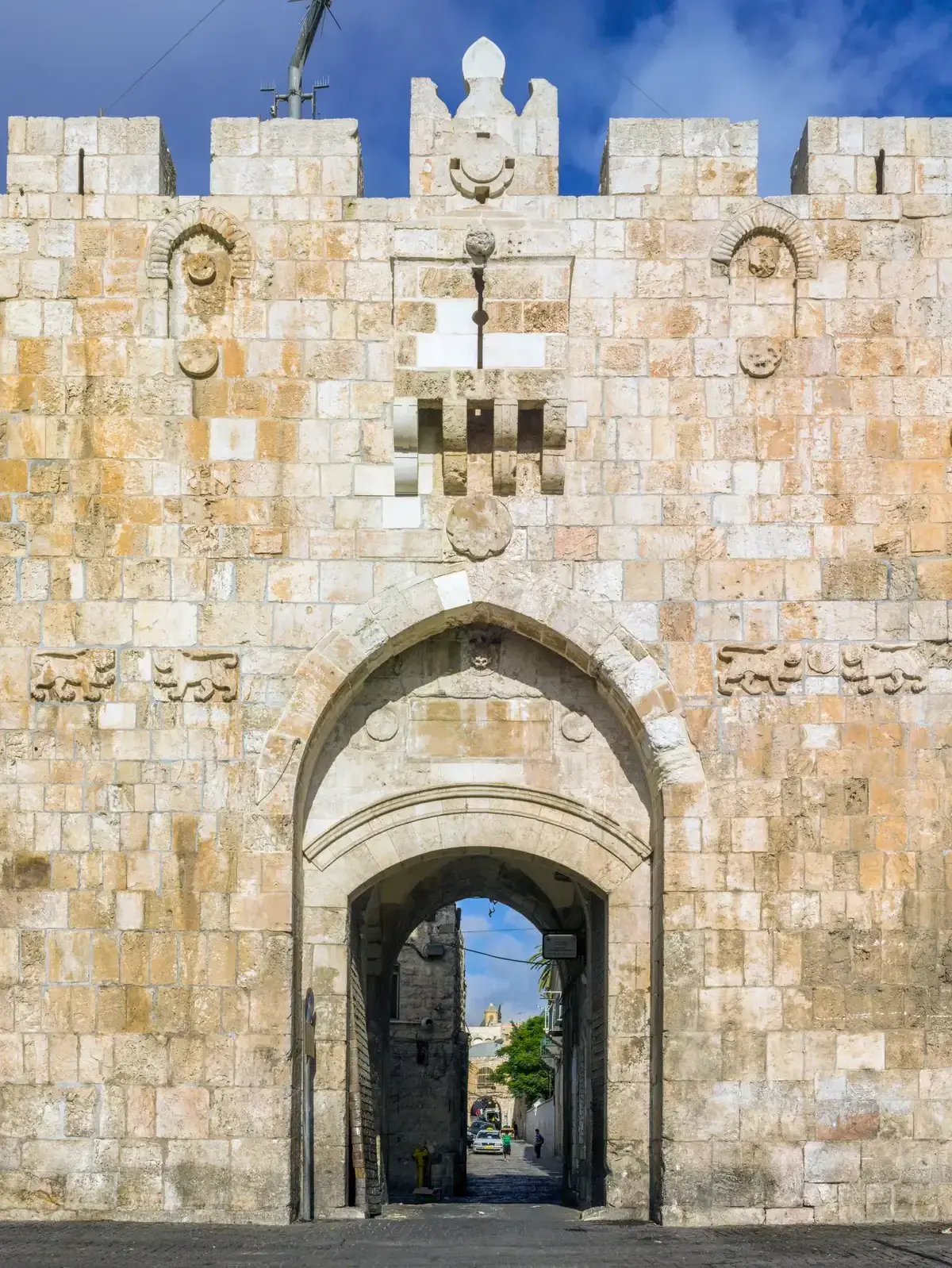
The pointed arch and battlements of Lions' Gate on the eastern wall. Photo: Godot13, CC BY-SA 4.0, via Wikimedia Commons
Quick answer The eight gates at a glance
There are eight named gates of Jerusalem Old City: seven are open, and the Golden Gate on the eastern wall is sealed. The present gates and walls were built under Ottoman Sultan Suleiman the Magnificent in the 16th century, with the New Gate added in the 1880s.
Key takeaways
- The walls run about 4.5 km, stand 5 to 15 m high and carry 35 towers. Walk them on the Ramparts Walk for ₪25.
- Several guided walks start at Jaffa Gate, including the Old City walking tour at $57 per person.
- Every gate, its Arabic and Hebrew names and its build year are set out in the gate-by-gate section.
- For two gates in more depth, see the Jaffa Gate and Damascus Gate guides.
The Gates at a Glance
Eight named gates serve the Old City walls. Seven admit people on foot today, the Golden Gate is sealed, and the wall also holds sealed Huldah Gates on the Temple Mount's southern side.
The Eight Named Gates
The table lists all eight gates with their alternative names, the part of the city each one opens into, and the year each took its present form. Where sources disagree on a date, both figures are shown. Only the Jaffa Gate breach and the widened Dung Gate are confirmed vehicle routes.
New Gate was added under Sultan Abdul Hamid II in the late 19th century.
| Gate | Other names | Opens into | Built |
|---|---|---|---|
| Jaffa Gate | Bab al-Khalil (Arabic), Sha'ar Yafo (Hebrew) | Christian, Muslim and Armenian quarters | 1538 |
| Damascus Gate | Bab al-Amoud (Arabic), gate of the column | Muslim Quarter bazaar | 1537 |
| New Gate | not stated | Christian Quarter | 1887 to 1889 |
| Herod's Gate | Bab al-Sahira (Arabic), Sha'ar HaPerachim or Flowers' Gate (Hebrew) | Muslim Quarter and Bab az-Zahra outside | Present form 1875 |
| Lions' Gate | Bab al-Asbat (Arabic), Sha'ar HaArayot (Hebrew), St Stephen's Gate (Christian name) | North-eastern wall, start of the Via Dolorosa route | 1538 to 1539 |
| Dung Gate | not stated | Jewish Quarter and the Western Wall | 1537 to 1541 (other source: 1538 to 1540) |
| Zion Gate | Sha'ar Tzion (Hebrew), Bab an-Nabi Dawud (Arabic) | Jewish Quarter, southern wall | July 1540 |
| Golden Gate | Sha'ar HaRahamim (Hebrew) | Eastern wall by the Temple Mount | Sealed, last sealed in 1541 |
Sources: Western Wall Heritage Foundation, Christian Information Center opening hours, Jerusalem tourism office
Gate by Gate
Each of the eight gates has its own name, date and role in the daily life of the walled city. The figures below come from the gates and walls records, and dates are given exactly as the sources state them.
Jaffa Gate
Jaffa Gate, Bab al-Khalil in Arabic and Sha'ar Yafo in Hebrew, was built in 1538. Its entrance bends through 90 degrees to slow attackers, with an overhead fighting cell called a mishikuli. Beside it, a wide breach was cut in 1898 so Kaiser Wilhelm II could enter on horseback and in carriages.
That breach is now the main route for vehicles into the Old City from the west, through a checkpoint open Sunday to Thursday 9:00 to 18:00 and Friday and holiday eves 9:00 to 13:00. Guided walks meet here, including the $57 Old City walking tour. Full detail is in the Jaffa Gate guide.
Damascus Gate
Damascus Gate, Bab al-Amoud in Arabic, meaning gate of the column, was built in its present form in 1537 under Suleiman. Beneath it lies a Roman gate from around 129 to 130 CE. Unlike at the other gates, steps lead down to the opening, and it empties straight onto the bazaar of the Muslim Quarter.
The excavation under the gate, called the Ancient City Gate, is open to pre-booked groups only according to the Christian Information Center's list. The Red Line light rail has a stop named Damascus Gate. This gate has its own page at Damascus Gate.
New Gate
The New Gate is the youngest of the eight, built between 1887 and 1889 under Sultan Abdul Hamid II to link the Christian Quarter with new neighbourhoods outside the walls. One source dates it to 1887 and another to 1889, so both are given here. It stands about 790 m above sea level, the highest point of the walls, and is the quickest way from the Old City to West Jerusalem.
Just outside stands the Notre Dame Hospice, completed in 1886. The Northern Promenade of the Ramparts Walk passes through New Gate on its way from Jaffa Gate to Herod's Gate.
Herod's Gate
Herod's Gate is Bab al-Sahira in Arabic and Sha'ar HaPerachim, Flowers' Gate, in Hebrew. It connects the Muslim Quarter with the Bab az-Zahra neighbourhood just outside the walls. The gate took its current form in 1875, long after Suleiman's building campaign.
Despite the name, no royal connection is recorded here. On the ramparts above, the Northern Promenade ends here, running from Jaffa Gate over the Christian and Muslim quarters, through New Gate and Damascus Gate.
Lions' Gate
Lions' Gate, Bab al-Asbat in Arabic and Sha'ar HaArayot in Hebrew, was built in 1538 and 1539 and stands about 13.7 m tall. Four animal carvings flank the gate. Historians read them as leopards of the Mamluk sultan Baibars, but the name says lions.
Christians call it St Stephen's Gate, and the Via Dolorosa is traditionally entered from here. The gate sits on the north-eastern wall. From it, walkers head into the Muslim Quarter toward the stations of the cross, which the Via Dolorosa guide follows in order.
Dung Gate
Dung Gate was built between 1537 and 1541 as a narrow pedestrian opening about 1.5 m wide. One source gives 1538 to 1540 instead. It was widened for vehicles in 1952 and again in 1984 and 1985, to a 4.5 m opening.
Today it is the main vehicle exit from the Old City and the access point for buses to the Western Wall. The Foundation says wheelchair access to the Western Wall plaza is only from Dung Gate.
Zion Gate
Zion Gate, Sha'ar Tzion in Hebrew and Bab an-Nabi Dawud in Arabic, was built in July 1540 on the southern wall and opens into the Jewish Quarter. The key was handed over on 13 May 1948 when British forces left, and the gate was restored in 2008. Its car access is not confirmed in the sources, so plan to arrive on foot.
King David's Tomb and the Room of the Last Supper sit outside on Mount Zion, stops covered by the $57 guided walk from Jaffa Gate.
Golden Gate
The Golden Gate, Sha'ar HaRahamim in Hebrew, is the one sealed gate of the eight. It stands on the eastern wall by the Temple Mount. It dates from the 6th century and was last sealed in 1541.
Several gates on the southern wall are sealed too, including the Single, Double and Triple Gates of the Temple Mount, also called the Huldah Gates.
The Walls Themselves
The gates only make sense with the walls around them. Here are the figures for the circuit and the ticket for walking on top of it.
Suleiman's Walls
The present walls were built by the Ottoman Sultan Suleiman the Magnificent. The Old City record gives the years 1535 to 1542, while the gates record gives 1533 to 1540, and both versions are printed here because the sources disagree. The circuit runs about 4.5 km, stands 5 to 15 m high, is about 3 m thick at the base and carries 35 towers.
Suleiman's walls originally had six gates. The New Gate was added in the 1880s, leaving seven in use today. The whole walled city covers 0.9 square kilometres and was added to the UNESCO World Heritage list in 1981, listed as endangered in 1982.
Inside it are four quarters: the Muslim in the northeast, the Christian in the northwest, the Jewish in the southeast and the Armenian, the smallest. The four quarters of Jerusalem guide walks through each one, and the homepage lists Old City Jerusalem tours that cover them.
The Ramparts Walk
You can walk on top of the walls on two marked promenades, both starting at Jaffa Gate. The Southern Promenade runs over the Armenian and Jewish quarters to Zion Gate. The Northern Promenade runs over the Christian and Muslim quarters, through New Gate and Damascus Gate, to Herod's Gate.
A ticket costs ₪25 for adults and ₪12 for students, retirees, children and soldiers. The walk is not wheelchair accessible. In July and August the ramparts open Sunday to Thursday 9:00 to 21:00, and on Fridays and Saturdays only the southern section opens, 9:00 to 14:00.
Winter hours are not stated. If you would rather have the walls explained from the ground, the pick for a first visit is a guided Jerusalem Old City tour starting where both promenades start.
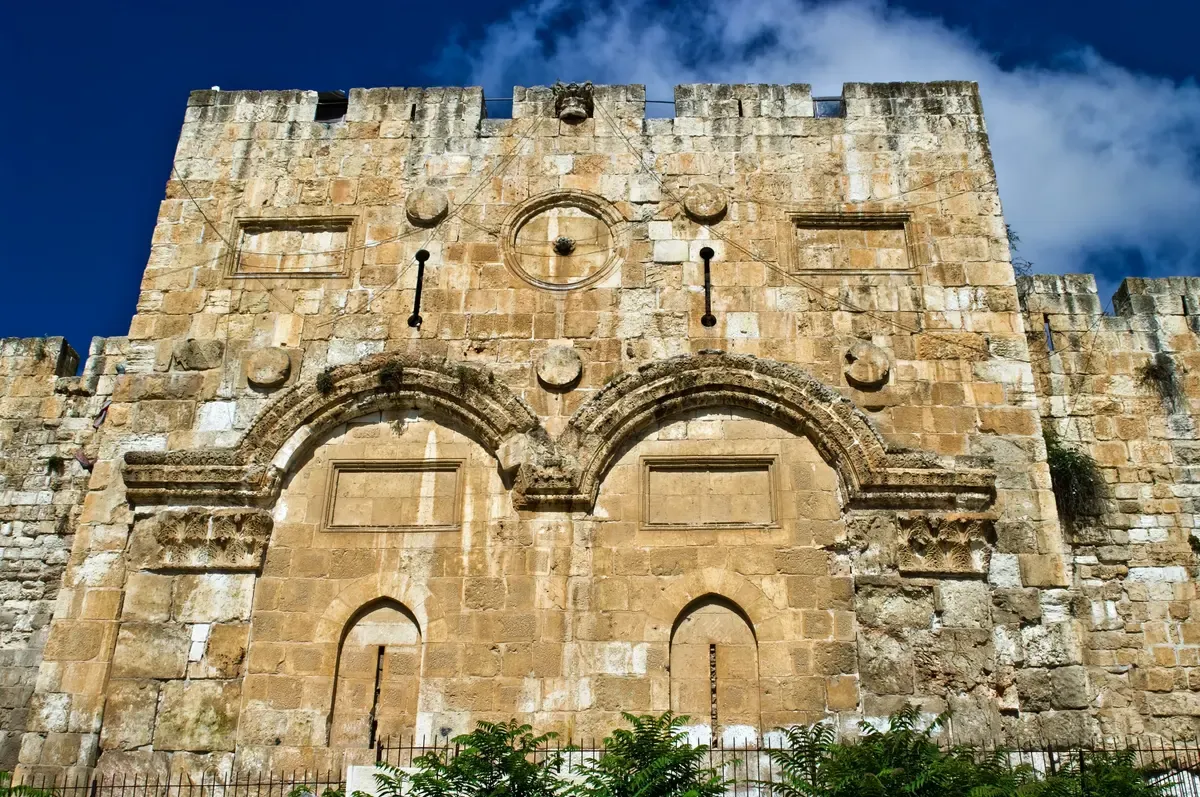
The sealed Golden Gate in the eastern wall below the Temple Mount. Photo: Nikodem Nijaki, CC BY-SA 3.0, via Wikimedia Commons
Gates of Jerusalem Old City: Questions
How many gates does the Old City of Jerusalem have?
Eight gates are named in the gates record: Jaffa, Damascus, New, Herod's, Lions', Dung, Zion and the sealed Golden Gate. Seven are open for daily use. Several more are sealed, including the Huldah Gates, the Single, Double and Triple Gates, in the southern wall of the Temple Mount. Each open gate is described in the gate-by-gate section.
Why is the Golden Gate sealed?
The Golden Gate, Sha'ar HaRahamim, stands on the eastern wall by the Temple Mount. It dates from the 6th century and was last sealed in 1541, and no reason for the sealing is given here.
Can you drive into the Old City through the gates?
Only two routes are confirmed. The wide breach beside Jaffa Gate, cut in 1898, is the main way for cars in from the west, through a checkpoint open Sunday to Thursday 9:00 to 18:00 and Friday and holiday eves 9:00 to 13:00. It admits approved vehicles such as shuttles up to 24 seats. Dung Gate, widened to 4.5 m, is the main vehicle exit and the access point for Western Wall buses. Car access at the other gates is not stated.
How long does it take to walk around the Old City of Jerusalem on the walls?
A total walking time is not stated, but the circuit itself measures about 4.5 km. The Southern Promenade runs from Jaffa Gate to Zion Gate, the Northern Promenade from Jaffa Gate through New Gate and Damascus Gate to Herod's Gate. Tickets cost ₪25 for adults and ₪12 for reduced categories, and both routes are covered in the Ramparts Walk section.
Which gate do tours start from?
Jaffa Gate, by a clear margin. The $57 four-hour walking tour starts and ends there, the dual narrative tour at $65 meets on the plaza outside it, and the private four quarters tour at $500 per group has the guide waiting just outside with your name on a sign. The Jaffa Gate guide covers the plaza, the 1538 gate and the 1898 breach in detail.
Which gate should I use for the Western Wall and the Via Dolorosa?
For the Western Wall, Dung Gate is the access point for the buses that serve the plaza, and the Foundation gives 15 to 20 minutes on foot from Jaffa Gate or Zion Gate. For the Via Dolorosa, the traditional entry is Lions' Gate, built in 1538 and 1539, which Christians also call St Stephen's Gate. From there the route runs through the Muslim Quarter to the Church of the Holy Sepulchre, the last stop of the stations of the cross.