 Jerusalem Old City Tour
Damascus Gate, Jerusalem: What to See at the Old City's Northern Gate
Damascus Gate is a northern entrance to Jerusalem's Old City, and this guide covers what you find there. The Ottoman gate of 1537 stands on a Roman gate from around 129 to 130 CE, steps lead down to the bazaar of the Muslim Quarter, and a Red Line light rail stop carries the gate's name. This guide sets out the names of the gate, the Roman remains below it, how to arrive by light rail or on foot, what the streets just inside lead to, and which Jerusalem Old City tours pass this way. For the other entrances to the walled city, see the guide to the gates of Jerusalem Old City.
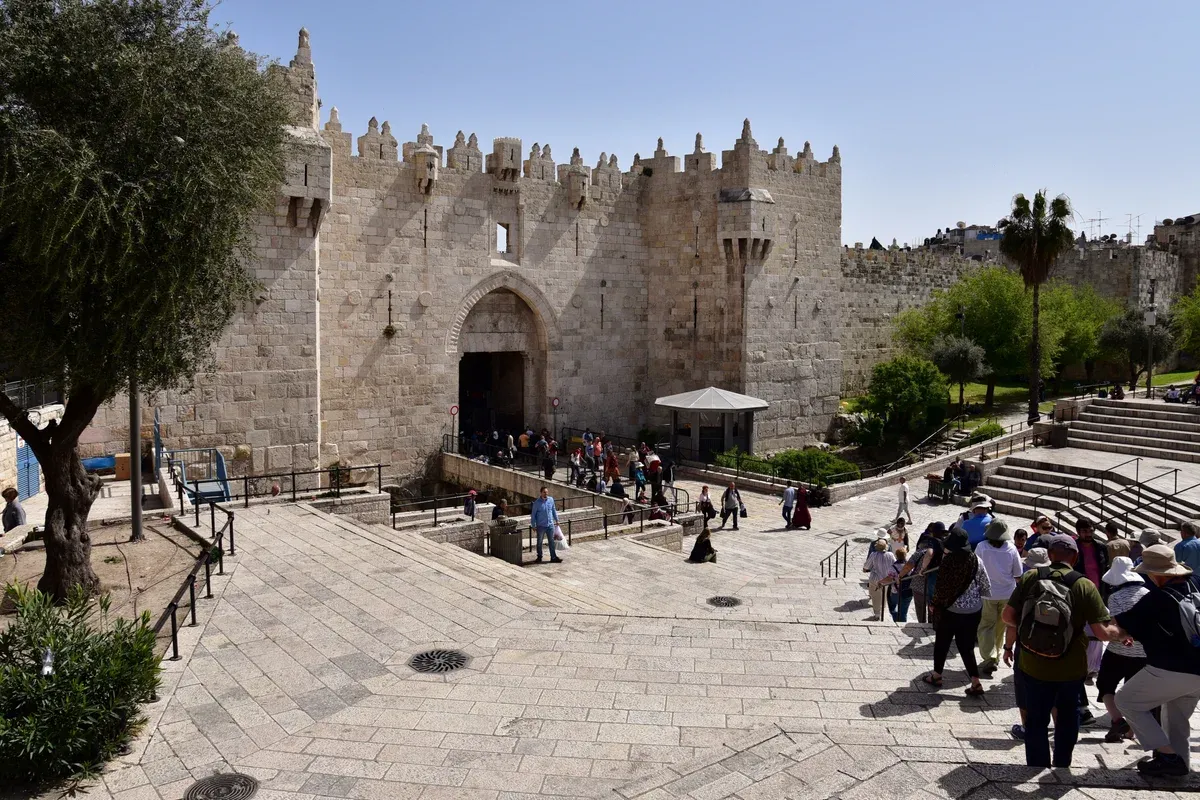
The towers and arched entrance of Damascus Gate seen from the plaza. Photo: Bahnfrend, CC BY-SA 4.0, via Wikimedia Commons
Quick answer Damascus Gate at a glance
Damascus Gate is an entrance to Jerusalem's Old City, built in its present form in 1537 under Sultan Suleiman the Magnificent.
Key takeaways
- The gate stands on a Roman gate from around 129 to 130 CE, and its Arabic name Bab al-Amoud means gate of the column. Read the history in the section on the gate and the Roman gate below it.
- The Red Line light rail has a stop named Damascus Gate near the Old City, with no daytime service on Shabbat. Details in arriving at Damascus Gate.
- Steps lead down from the gate into the bazaar of the Muslim Quarter, the route toward the Via Dolorosa. See what is through the gate.
- The cheapest guided Old City walk that covers the quarters is the Jerusalem Old City Half-Day Tour at $39 per person for 3 hours, and the full comparison is in Damascus Gate on a tour.
The Gate and the Roman Gate Below It
Damascus Gate carries layers of building from the Roman period and the Ottoman period, one on top of the other, and both are part of the visit.
Names of the Gate
The gate is known in Arabic as Bab al-Amoud, which means gate of the column, and in English as Damascus Gate. Both names describe the same structure. If you are comparing the gates of the walled city, the page on the gates of Jerusalem Old City lists all eight named gates, including the sealed Golden Gate.
The present city walls were built by Sultan Suleiman the Magnificent, with sources giving 1535 to 1542 or 1533 to 1540 for the work. They run about 4.5 km, stand 5 to 15 m high, are about 3 m thick at the base and carry 35 towers. Suleiman's walls originally had six gates, the New Gate was added in 1887, and seven gates are in use today.
- Arabic: Bab al-Amoud, gate of the column
- English: Damascus Gate
- Built in its present form: 1537, under Suleiman
- Roman gate below: around 129 to 130 CE
The Ottoman Gate of 1537
The gate you walk through was built in 1537 under Sultan Suleiman, within his great wall-building project of the 1530s and 1540s. Unlike the other open gates, Damascus Gate has steps leading down to it, so you descend from the street level outside to pass through, and it opens directly onto the bazaar of the Muslim Quarter inside.
The Ramparts Walk Northern Promenade passes New Gate, Damascus Gate and Herod's Gate in that order. Herod's Gate got its current form in 1875, and the New Gate was added in 1887 to link the Christian Quarter with neighbourhoods outside the walls. Keep the years straight when reading: 1537 is Damascus Gate, 1875 is Herod's Gate and 1887 is the New Gate.
| Gate | Built or rebuilt | Notes from the sources |
|---|---|---|
| Damascus Gate | 1537 | Steps lead down to it, opens onto the Muslim Quarter bazaar |
| Herod's Gate | 1875 | Links the Muslim Quarter with Bab az-Zahra outside |
| New Gate | 1887 | About 790 m above sea level, highest point of the walls |
The Roman Gate of About 129 to 130 CE
Below the Ottoman gate lies a much older one. Damascus Gate sits on a Roman gate from around 129 to 130 CE.
Visiting that underground gate is not a walk-in affair. The Ancient City Gate excavation under Damascus Gate is open to pre-booked groups only, according to the Christian Information Center's published list of opening hours. Independent travellers cannot count on entering it, and no ticket price is stated. For another underground site, see the guide to the City of David underground tour.
Sources: Western Wall Heritage Foundation, Christian Information Center opening hours, Jerusalem tourism office
Arriving at Damascus Gate
A light rail stop carries the gate's name, and you can also arrive on foot or along the top of the wall.
By Light Rail
The Jerusalem Light Rail Red Line has a stop named Damascus Gate, one of three stops around the Old City alongside City Hall and Jaffa Center. The Red Line is 22.5 km long with 35 stations, and it opened in December 2011. You pay with the Rav-Kav card.
Two sources give slightly different frequencies. Wikipedia says trains run every 3 minutes at rush hour and every 6 minutes otherwise. The Christian Information Center says every 6 to 7 minutes from 5:00 to midnight, with the last Friday train around 14:15 and Saturday service starting about 18:00. Both agree on the essentials: no daytime Shabbat service, and service resumes once Shabbat ends. On running hours, Wikipedia gives Sunday to Thursday 5:30 to 23:30 and Friday until an hour before sundown, with no service on Shabbat or Jewish holidays. Check the operator before you travel.
| Day | Service | Source note |
|---|---|---|
| Sunday to Thursday | 5:30 to 23:30 | Wikipedia |
| Friday | Until about an hour before sundown, last train around 14:15 | Wikipedia and Christian Information Center |
| Saturday | No daytime service, evening service after Shabbat ends | Both sources agree |
On Foot, and Over the Wall
Damascus Gate is the natural entrance if you are coming by light rail. Inside, the gate opens onto the bazaar of the Muslim Quarter, and the walk through the markets to the Via Dolorosa is the classic route.
There is also a way to arrive above the gate rather than through it. The Ramparts Walk Northern Promenade starts at Jaffa Gate and runs along the top of the wall over the Christian and Muslim quarters, passing through New Gate and Damascus Gate before ending at Herod's Gate, also called Flower's Gate. A ticket costs ₪25 for adults and ₪12 for students, retirees, children and soldiers. In July and August the ramparts open Sunday to Thursday 9:00 to 21:00, and on Fridays and Saturdays only the southern section opens, 9:00 to 14:00. The walk is not wheelchair accessible. Both promenades start at Jaffa Gate, so read the Ramparts Walk notes before planning the northern stretch.
- Northern Promenade: Jaffa Gate, New Gate, Damascus Gate, Herod's Gate
- Ticket: ₪25 adult, ₪12 reduced
- July and August hours: Sunday to Thursday 9:00 to 21:00
- Friday and Saturday: only the southern section, 9:00 to 14:00
Just Outside the Gate
Two sites are worth factoring into the visit. The Garden Tomb, outside Damascus Gate, is open Monday to Thursday and Saturday 9:00 to 13:00 and closed Friday and Sunday. Zedekiah's Cave, also called Solomon's Quarries, lies between Damascus Gate and Herod's Gate.
It costs ₪25 self-guided, or ₪12 for children, students and seniors, and is open Sunday to Thursday 9:00 to 17:00 in summer and 9:00 to 16:00 in winter, closed Friday and Saturday. An audio-visual show costs ₪40 or ₪30 and runs Sunday to Thursday at 16:00 by reservation, with arrival 15 minutes early.
| Site | Ticket | Hours |
|---|---|---|
| Garden Tomb | not stated | Monday to Thursday and Saturday 9:00 to 13:00, closed Friday and Sunday |
| Zedekiah's Cave | ₪25 adult, ₪12 reduced | Sunday to Thursday, 9:00 to 17:00 summer, 9:00 to 16:00 winter |
| Zedekiah's Cave audio-visual show | ₪40 or ₪30 | Sunday to Thursday 16:00 by reservation, arrive 15 minutes early |
Through the Gate
Inside Damascus Gate you step straight into the Muslim Quarter, the most populous of the Old City's four quarters and the home of its market streets.
The Muslim Quarter Markets
Damascus Gate opens onto the bazaar of the Muslim Quarter, and the market streets are what most visitors meet first. The Muslim Quarter had about 21,850 residents in 2020, by far the largest population of the four quarters, and the market streets serve residents and visitors at once.
The full page on the four quarters of Jerusalem compares all four, including the resident counts, but the short version for this gate is simple: walk in and you are in the Muslim Quarter immediately.
| Quarter | Residents in 2020 | Position in the Old City |
|---|---|---|
| Muslim | about 21,850 | Northeast, entered by Damascus Gate |
| Christian | about 3,870 | Northwest, entered by New Gate and Jaffa Gate |
| Jewish | about 3,240 | Southeast, Zion Gate is in the quarter |
| Armenian | not stated | The smallest quarter |
The Route Toward the Via Dolorosa
From the bazaar you can reach the Via Dolorosa, the route of the Stations of the Cross that ends at the Church of the Holy Sepulchre. The Via Dolorosa is traditionally entered from Lions' Gate on the northeastern wall, built in 1538 and 1539. The guide to the Via Dolorosa walks the stations in order, and the Church of the Holy Sepulchre page covers the church at the end of the route.
Also in the Muslim Quarter is a paid site worth knowing: the Basilica of St Anne and the Pools of Bethesda, open Monday to Saturday 8:00 to 12:00 and 14:00 to 16:00 and closed Sunday, charging ₪12 for adults and ₪10 for students, with the St Anne museum open Tuesday, Thursday and Saturday 9:00 to 12:00 and 14:00 to 16:00. The Western Wall and the Temple Mount have their own guides.
- Basilica of St Anne and Pools of Bethesda: ₪12 adult, ₪10 student, closed Sunday
- St Anne museum: Tuesday, Thursday and Saturday 9:00 to 12:00 and 14:00 to 16:00
- Via Dolorosa: traditionally entered from Lions' Gate
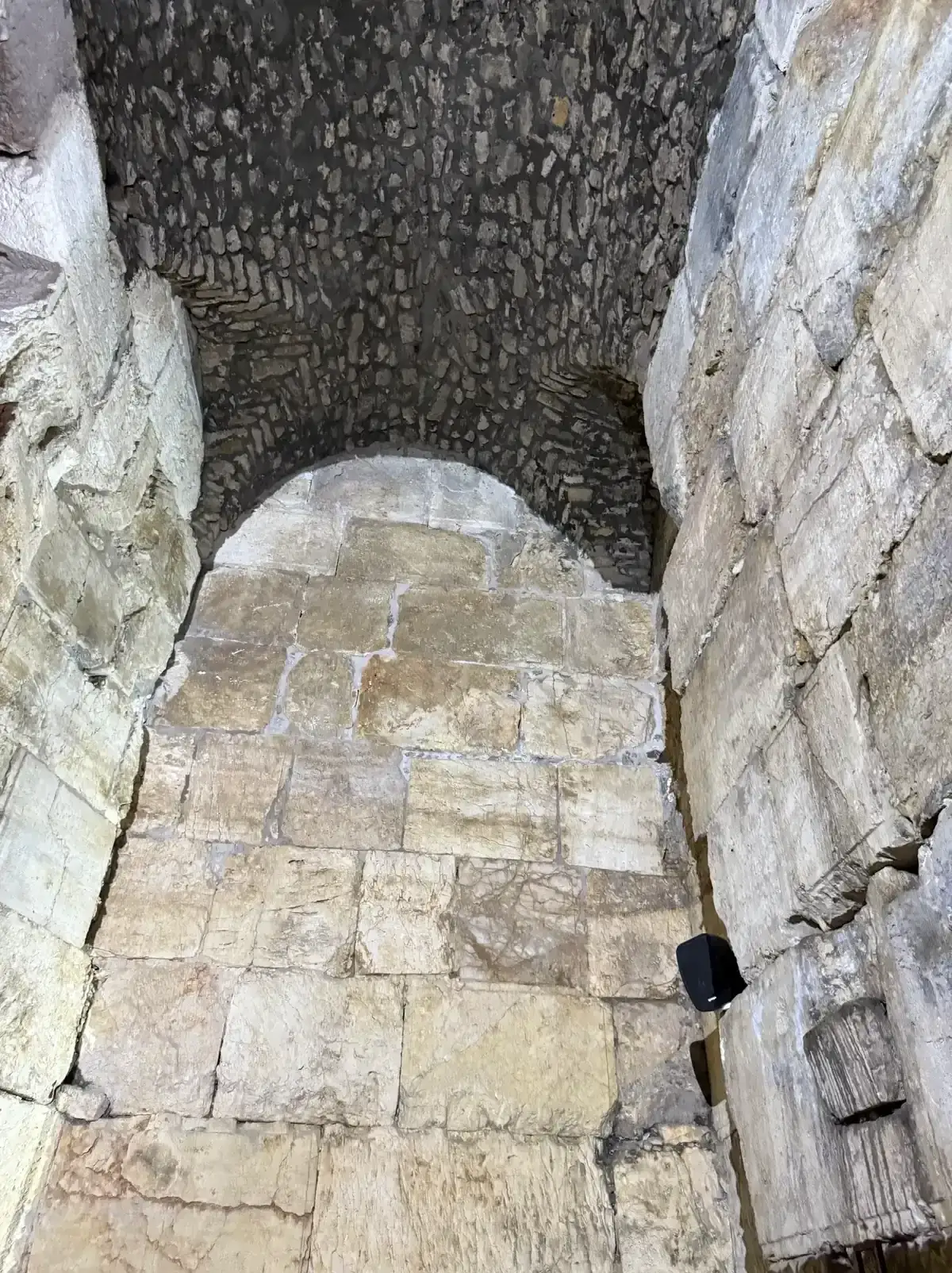
The Roman-era lower gate tower under Damascus Gate, seen from inside. Photo: Unknown author Unknown author, CC BY 2.5, via Wikimedia Commons
Damascus Gate on a Tour
No tour on this site meets at Damascus Gate, but several cover the Muslim Quarter, and their prices and routes differ a lot.
Tours That Cover the Muslim Quarter
The cheapest way to see the quarters with a guide is the Jerusalem Old City Half-Day Tour at $39 per person, 3 hours from Jaffa Gate through the Jewish Quarter and the Via Dolorosa to the Church of the Holy Sepulchre, with groups capped at 25. Note that its meeting point is the David Citadel Hotel, not Damascus Gate, and entry fees are not listed as included. At $57 per person, the Jerusalem Old City Walking Tour runs 4 hours from Jaffa Gate and has 414 reviews at 4.8.
The 4.5-hour dual narrative walk at $65 per person uses two guides and caps groups at 20, and the private four quarters tour costs $500 per group, not per person, for 5 hours. Day tours from Tel Aviv also cover the quarters, including the Jerusalem Old City Tour from Tel Aviv at $90 per person over 10.5 hours. No tour includes lunch, and the walk-only tours include no hotel pickup.
| Tour | Price | Duration | Muslim Quarter coverage | Meeting point |
|---|---|---|---|---|
| Jerusalem Old City Half-Day Tour | $39 per person | 3 hours | Yes, all four quarters | David Citadel Hotel, Jerusalem |
| Jerusalem Old City Walking Tour | $57 per person | 4 hours | Yes, via the Via Dolorosa | Jaffa Gate |
| Dual Narrative Tour | $65 per person | 4.5 hours | Not listed, two guides | Plaza outside Jaffa Gate |
| Old City Tour from Tel Aviv | $90 per person | 10.5 hours | Yes, all four quarters | Abraham Tel Aviv, HaRakevet St 8 |
| Four Quarters Private Tour | $500 per group | 5 hours | Yes, private itinerary | Just outside Jaffa Gate |
What the Tours do Not Include
Read the inclusions before booking, because they are honest and not generous. The $39 half-day tour includes an expert guide only, and entry fees are not listed as included. The $57 walking tour and the $65 dual narrative walk are the same: guided touring only, no entry fees listed as included, no food. The Tel Aviv day tours add transport, and the Jerusalem and Bethlehem Tour from Tel Aviv at $121 per person is the only one on the homepage listing hotel pickup from nine Tel Aviv hotels, but its Old City portion is about 2.5 hours and its listing names the Armenian, Christian and Jewish quarters.
If you want to see the Roman gate under Damascus Gate itself, remember that the excavation is open to pre-booked groups only. None of the tours listed here state that they enter it, so ask the operator before assuming. For the full pricing picture across every tour, the homepage comparison table puts all the cards side by side.
Damascus Gate FAQ
Why is it called Damascus Gate?
The Arabic name Bab al-Amoud means gate of the column, and the present 1537 gate sits on a Roman gate from around 129 to 130 CE. The guide to Damascus Gate covers both names and the Roman gate below.
How old is Damascus Gate?
Two dates answer this. The Ottoman gate in its present form was built in 1537 under Sultan Suleiman the Magnificent, and beneath it lies a Roman gate from around 129 to 130 CE. The excavation under the gate is open to pre-booked groups only, according to the Christian Information Center list, as explained in the gate and the Roman gate below it.
How do I get to Damascus Gate by public transport?
Take the Jerusalem Light Rail Red Line to the stop named Damascus Gate, one of three stops around the Old City with City Hall and Jaffa Center. Wikipedia gives Sunday to Thursday 5:30 to 23:30 and the Christian Information Center gives 5:00 to midnight, with no daytime Shabbat service, and you pay with the Rav-Kav card. Full times are in arriving at Damascus Gate.
What is inside Damascus Gate?
Steps lead down through the gate into the bazaar of the Muslim Quarter, the market streets of the Old City's largest quarter, with about 21,850 residents in 2020. From there you can reach the Via Dolorosa. The page on the four quarters of Jerusalem compares all four.
Can you walk over Damascus Gate on the wall?
Yes. The Ramparts Walk Northern Promenade runs from Jaffa Gate over the Christian and Muslim quarters, through New Gate and Damascus Gate, ending at Herod's Gate. A ticket costs ₪25 for adults and ₪12 reduced, and in July and August it opens Sunday to Thursday 9:00 to 21:00, with Friday and Saturday limited to the southern section 9:00 to 14:00. Details in on foot, and over the wall.
Are there tours that start or pass through Damascus Gate?
No tour in the comparison meets at Damascus Gate, and several start at Jaffa Gate, but several cover the Muslim Quarter streets just inside it, including the Jerusalem Old City Half-Day Tour at $39 per person for 3 hours and the 4-hour Jerusalem Old City Walking Tour at $57. Prices and meeting points are compared in Damascus Gate on a tour.